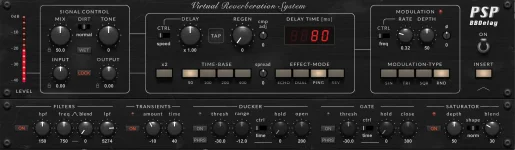
PSP BBDelay applies its high-pass and low-pass damping on every delay repetition or reverb processing cycle, not just once at the output. A filter after a delay cannot do the same job. It gives every repeat the same final EQ curve instead of letting the spectrum change as the signal keeps circulating.
The difference is easy to miss because both approaches can sound darker or thinner. Inside PSP BBDelay feedback filtering, the filter sits in the regenerative process, so later echoes have lived through more filtering than earlier ones. Feedback is no longer only deciding how long the tail lasts.
This also separates the filter from the BBD bandwidth loss at long delay times. The delay engine can already soften the top end, while feedback filtering adds another frequency-dependent change on each trip around the loop.
The important word is every. In a simplified loop, a frequency that loses 3 dB on one pass can be 6 dB down after two passes and 12 dB down after four, before other parts of the processor are considered. Repetition turns an ordinary filter curve into a changing decay shape.
This is why feedback filtering can clear a mix without making the first moments of the effect feel tiny. Bass can survive near the front, then fall away faster as the tail develops. High frequencies can do the same thing in reverse, beginning with useful articulation before the later repeats sink behind the dry sound.
The broader DSP idea is formalized in frequency-dependent decay filters in feedback delay networks, where attenuation inside recirculating paths controls how quickly different frequency regions die away. BBDelay is not a room-modeling FDN, but the useful principle is the same. Put filtering inside a repeating path and the frequency response becomes part of the decay behavior.
A modest bell setting can make the tail feel voiced rather than simply dark. Pick a frequency near the useful body of a snare, synth, guitar, or vocal, then let the high and low damping trim material around it. As the repeats recirculate, the chosen region can become more noticeable relative to frequencies being lost faster.
This is a better way to think about resonance here than treating it as a static EQ bump. The bell is participating in repeated processing. A small tonal preference can become much more obvious several echoes later because the same spectral relationship keeps being revisited.
Feedback amount changes how far this process gets to develop. Low regeneration gives the filters only a few passes to leave a mark. Higher regeneration keeps material in circulation longer, so subtle damping or bell shaping has more time to become audible without needing an extreme setting.
Filtering inside the feedback path behaves differently because later repeats have accumulated more processing history. The first audible echo can stay relatively present while the fifth has lost far more top or bottom. You get movement across the tail instead of one fixed color painted over the whole return.
A useful test is to keep regeneration high enough for five or six clear repeats, turn the bell blend down, and start with gentle high-pass and low-pass settings. Listen to the first repeat, then the last two. Move only one cutoff, and the changing spectral slope across the echo train becomes much easier to hear.
Afterward, bring in the bell and sweep its frequency slowly while the same sound repeats. The interesting setting is usually not the loudest one. It is the point where later echoes keep a recognizable tonal center while the rest of the spectrum quietly falls away.
The difference is easy to miss because both approaches can sound darker or thinner. Inside PSP BBDelay feedback filtering, the filter sits in the regenerative process, so later echoes have lived through more filtering than earlier ones. Feedback is no longer only deciding how long the tail lasts.
This also separates the filter from the BBD bandwidth loss at long delay times. The delay engine can already soften the top end, while feedback filtering adds another frequency-dependent change on each trip around the loop.
Feedback filtering changes the decay itself
BBDelay gives the filter section a high-pass control for low-frequency damping and a low-pass control for high-frequency damping. Push the high-pass cutoff upward and more bass disappears on every repetition. Pull the low-pass cutoff downward, and the upper frequencies are reduced more heavily each time the signal comes back.The important word is every. In a simplified loop, a frequency that loses 3 dB on one pass can be 6 dB down after two passes and 12 dB down after four, before other parts of the processor are considered. Repetition turns an ordinary filter curve into a changing decay shape.
This is why feedback filtering can clear a mix without making the first moments of the effect feel tiny. Bass can survive near the front, then fall away faster as the tail develops. High frequencies can do the same thing in reverse, beginning with useful articulation before the later repeats sink behind the dry sound.
The broader DSP idea is formalized in frequency-dependent decay filters in feedback delay networks, where attenuation inside recirculating paths controls how quickly different frequency regions die away. BBDelay is not a room-modeling FDN, but the useful principle is the same. Put filtering inside a repeating path and the frequency response becomes part of the decay behavior.
The bell filter can leave a spectral fingerprint
The high-pass and low-pass controls mostly decide what gets progressively removed. BBDelay also gives you a bell frequency control and a blend between flat response and the bell filter response. This lets one selected region behave differently from the broad damping on either side.A modest bell setting can make the tail feel voiced rather than simply dark. Pick a frequency near the useful body of a snare, synth, guitar, or vocal, then let the high and low damping trim material around it. As the repeats recirculate, the chosen region can become more noticeable relative to frequencies being lost faster.
This is a better way to think about resonance here than treating it as a static EQ bump. The bell is participating in repeated processing. A small tonal preference can become much more obvious several echoes later because the same spectral relationship keeps being revisited.
Feedback amount changes how far this process gets to develop. Low regeneration gives the filters only a few passes to leave a mark. Higher regeneration keeps material in circulation longer, so subtle damping or bell shaping has more time to become audible without needing an extreme setting.
Output EQ cannot copy recursive filtering
Put an EQ after the plug-in and every wet event passes through it once. A 4 kHz low-pass at the output can make the entire delay dark, but the first repeat and the fifth repeat still meet the same final filter. Their tonal difference has to come from somewhere else.Filtering inside the feedback path behaves differently because later repeats have accumulated more processing history. The first audible echo can stay relatively present while the fifth has lost far more top or bottom. You get movement across the tail instead of one fixed color painted over the whole return.
A useful test is to keep regeneration high enough for five or six clear repeats, turn the bell blend down, and start with gentle high-pass and low-pass settings. Listen to the first repeat, then the last two. Move only one cutoff, and the changing spectral slope across the echo train becomes much easier to hear.
Afterward, bring in the bell and sweep its frequency slowly while the same sound repeats. The interesting setting is usually not the loudest one. It is the point where later echoes keep a recognizable tonal center while the rest of the spectrum quietly falls away.