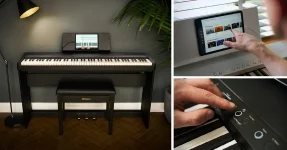
Roland lists the FP-40 at 14 kg with its music rest attached, while Kawai lists the ES120 at 12.5 kg in the same configuration. Both are portable 88-key digital pianos with weighted hammer actions, Bluetooth audio and MIDI, built-in speakers, and dedicated line outputs.
The obvious comparison starts with feel, but ownership quickly exposes a bigger difference. Roland has built the FP-40 around a connected software ecosystem, while Kawai keeps more of the ES120 experience compact, conventional, and immediately reachable from the instrument.
The Roland FP-40 connected piano system combines PHA-4 Standard action, Piano Reality sound, Wi-Fi, Piano Sphere, and Roland Piano App. Kawai answers with its Responsive Hammer Compact action, Harmonic Imaging sound, PianoRemote, PiaBookPlayer, and a smaller 25-voice library.
Kawai takes the opposite approach to abundance. The ES120 has 25 voices, 192-note polyphony, four registration memories, Dual and Split modes, and 100 drum rhythms. Its internal recorder can hold three songs of roughly 15,000 notes in total, while the FP-40 records one single-part MIDI song internally.
Speaker power is close enough that wattage alone should not decide anything. Roland uses two 12-watt amplifiers with 8-by-12-centimeter speakers, while Kawai runs two 10-watt amplifiers through a pair of 12-centimeter drivers. Cabinet design and where you place the piano will affect what you hear as much as the small numerical gap.
Recent owner discussions around this exact pairing repeatedly split over touch, with some players describing the Roland as heavier and others preferring its resistance. Personal reactions to the Kawai often run the other way. Neither description should be treated as a universal property because technique, hand strength, repertoire, and familiarity with acoustic actions all change how a keyboard feels.
Finger contact is not a trivial part of piano control. Piano touch and timing feedback has been examined experimentally in trained players, with tactile information at finger-key contact linked to timing control. A ten-minute store test therefore tells you more about this particular difference than another hour spent comparing action names online.
The app-side adjustment tools also differ. Kawai exposes 17 Virtual Technician parameters through PianoRemote, including voicing, damper resonance, hammer delay, minimum touch, temperament, half-pedal adjustment, and soft-pedal depth. Roland's Piano Designer offers its own deeper controls through Roland Piano App, including lid position, string resonance, cabinet resonance, temperament, and per-note tuning, volume, and character.
Roland answers with a more modern device workflow. Its USB-C port carries audio and MIDI and can provide power to compatible USB Power Delivery smartphones, while a separate USB-A port accepts flash storage. The FP-40 also has built-in Wi-Fi, Bluetooth 5.4, stereo outputs, and a headset-compatible mini jack aimed partly at lessons, streaming, and content creation.
The difference becomes concrete when a tablet lives beside the music rest. FP-40 owners can move between Piano Sphere for guided learning and Roland Piano App for deeper instrument control, while ES120 owners can use PianoRemote for settings and PiaBookPlayer for compatible lesson material. Roland asks software to carry more of the instrument's identity.
Kawai leaves a few useful jobs closer to traditional digital-piano habits. Registrations are valuable if you repeatedly switch between saved setups, and 100 rhythm patterns can make solitary practice less dry without opening another app. Two headphone sockets are also quietly useful for teacher-and-student sessions or late-night playing with another person.
Pedal upgrades follow the same split. Kawai supports the F-10H half-damper pedal, the portable GFP-3 triple-pedal unit, or the F-351 pedal board with its HML-2 stand, while Roland supports continuous damper control with compatible pedals and the KPD-70 three-pedal board on its KSF-40 stand. A portable purchase can therefore grow into a fixed home setup on either side without replacing the piano itself.
The obvious comparison starts with feel, but ownership quickly exposes a bigger difference. Roland has built the FP-40 around a connected software ecosystem, while Kawai keeps more of the ES120 experience compact, conventional, and immediately reachable from the instrument.
The Roland FP-40 connected piano system combines PHA-4 Standard action, Piano Reality sound, Wi-Fi, Piano Sphere, and Roland Piano App. Kawai answers with its Responsive Hammer Compact action, Harmonic Imaging sound, PianoRemote, PiaBookPlayer, and a smaller 25-voice library.
The same price class hides different priorities
Roland gives the FP-40 256-note polyphony and 305 internal tones, although only 40 can be selected directly from the piano. The other 265 require the Roland Piano App, so the huge sound count comes with a clear dependence on a phone or tablet when you want to explore beyond the front-panel set.Kawai takes the opposite approach to abundance. The ES120 has 25 voices, 192-note polyphony, four registration memories, Dual and Split modes, and 100 drum rhythms. Its internal recorder can hold three songs of roughly 15,000 notes in total, while the FP-40 records one single-part MIDI song internally.
Speaker power is close enough that wattage alone should not decide anything. Roland uses two 12-watt amplifiers with 8-by-12-centimeter speakers, while Kawai runs two 10-watt amplifiers through a pair of 12-centimeter drivers. Cabinet design and where you place the piano will affect what you hear as much as the small numerical gap.
The key actions deserve a real test
The FP-40 uses Roland's PHA-4 Standard action with escapement, Ivory Feel surfaces, graded weighting, and triple-sensor detection. The ES120 uses Kawai's Responsive Hammer Compact action with grade-weighted hammers and matte key surfaces, but the mechanical feel is noticeably different enough that specifications cannot settle the choice for your hands.Recent owner discussions around this exact pairing repeatedly split over touch, with some players describing the Roland as heavier and others preferring its resistance. Personal reactions to the Kawai often run the other way. Neither description should be treated as a universal property because technique, hand strength, repertoire, and familiarity with acoustic actions all change how a keyboard feels.
Finger contact is not a trivial part of piano control. Piano touch and timing feedback has been examined experimentally in trained players, with tactile information at finger-key contact linked to timing control. A ten-minute store test therefore tells you more about this particular difference than another hour spent comparing action names online.
The app-side adjustment tools also differ. Kawai exposes 17 Virtual Technician parameters through PianoRemote, including voicing, damper resonance, hammer delay, minimum touch, temperament, half-pedal adjustment, and soft-pedal depth. Roland's Piano Designer offers its own deeper controls through Roland Piano App, including lid position, string resonance, cabinet resonance, temperament, and per-note tuning, volume, and character.
Daily hardware changes the ownership experience
The ES120 makes a strong practical case for shared and mobile use. It has separate quarter-inch and eighth-inch headphone sockets, dedicated stereo line outputs, four registrations for recalling setups, and a listed weight of 1.5 kg below the FP-40 when both music rests are attached.Roland answers with a more modern device workflow. Its USB-C port carries audio and MIDI and can provide power to compatible USB Power Delivery smartphones, while a separate USB-A port accepts flash storage. The FP-40 also has built-in Wi-Fi, Bluetooth 5.4, stereo outputs, and a headset-compatible mini jack aimed partly at lessons, streaming, and content creation.
The difference becomes concrete when a tablet lives beside the music rest. FP-40 owners can move between Piano Sphere for guided learning and Roland Piano App for deeper instrument control, while ES120 owners can use PianoRemote for settings and PiaBookPlayer for compatible lesson material. Roland asks software to carry more of the instrument's identity.
Kawai leaves a few useful jobs closer to traditional digital-piano habits. Registrations are valuable if you repeatedly switch between saved setups, and 100 rhythm patterns can make solitary practice less dry without opening another app. Two headphone sockets are also quietly useful for teacher-and-student sessions or late-night playing with another person.
Pedal upgrades follow the same split. Kawai supports the F-10H half-damper pedal, the portable GFP-3 triple-pedal unit, or the F-351 pedal board with its HML-2 stand, while Roland supports continuous damper control with compatible pedals and the KPD-70 three-pedal board on its KSF-40 stand. A portable purchase can therefore grow into a fixed home setup on either side without replacing the piano itself.