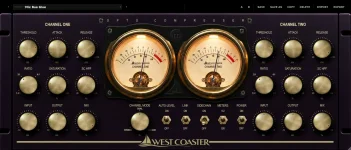
West Coaster routes its external sidechain through the same per-channel high-pass filter used by its internal detector path. This small routing detail separates two controls producers often lump together, because filtering a detector is not the same operation as replacing its trigger source.
A compressor normally derives gain reduction from a control signal related to the audio passing through it. A sidechain high-pass filter changes the frequency content of that control signal before the detector decides how hard to compress. The audible low end is not removed simply because the detector stops reacting strongly to it.
An external sidechain changes the source feeding the detector instead. Put a compressor on a bass track and feed its external key from a kick, and the kick controls when the bass is reduced even though the kick itself does not pass through the bass compressor.
This distinction is easy to hear if your compressor provides sidechain audition. Sweep the filter upward while listening to the detector, and the low body of the kick recedes, yet switching audition off returns the full-frequency mix. Gain reduction now follows a different spectral balance even though the signal being turned down still contains its bass.
The technique is also different from multiband compression. A broadband compressor with a detector HPF still applies one gain envelope to the full signal path, including frequencies below the filter point. Research and patented dynamics systems use the same broad principle of frequency-selective sidechain detection, where filtering decides what information drives attenuation rather than automatically removing those frequencies from the program audio.
Filter movement can also change how often the threshold is crossed. Push the HPF higher, and the detector may receive less total energy, so an unchanged threshold can produce less gain reduction. Comparing filter settings fairly often means watching the gain-reduction meter and readjusting threshold rather than assuming the same number represents the same compression.
A vocal can key a music bus so dense instrumentation moves down during phrases. A dry percussion track can control a heavily processed ambience return without the dry hit entering that return. The compressor still applies gain reduction to its own signal path, while the external source supplies the timing and level information used to create the envelope.
This is where the West Coaster sidechain routing becomes more interesting than a simple external-input switch. Its external key passes through the same per-channel SC HPF, so selecting an outside trigger does not make detector filtering redundant. Source selection and spectral selection remain separate decisions.
Howdy Compressor illustrates the other side of the distinction. It provides the 20 Hz to 500 Hz detector high-pass filter but does not provide West Coaster's external sidechain input. You can make Howdy less sensitive to bass inside its own detector path, but you cannot replace that detector source with a separate kick, vocal, or control bus.
The order of operations also explains a common setup mistake. Producers sometimes enable an external sidechain, see too much gain reduction, and immediately change attack or release. If unwanted low-frequency energy in the key is driving the detector, filtering the key can solve the trigger problem without changing the compressor's timing behavior.
Use the controls according to the problem in front of you. Reach for the sidechain HPF when the right source is already driving the compressor but the wrong frequencies are dominating its decisions. Use an external sidechain when the compressor should follow a different source altogether, then filter that key if its own spectrum still produces the wrong trigger pattern.
A compressor normally derives gain reduction from a control signal related to the audio passing through it. A sidechain high-pass filter changes the frequency content of that control signal before the detector decides how hard to compress. The audible low end is not removed simply because the detector stops reacting strongly to it.
An external sidechain changes the source feeding the detector instead. Put a compressor on a bass track and feed its external key from a kick, and the kick controls when the bass is reduced even though the kick itself does not pass through the bass compressor.
A sidechain HPF changes what the detector hears
Low frequencies can dominate a broadband detector because they often carry substantial energy. On a drum bus or full mix, a large kick or sub hit may push the compressor over threshold and pull the entire signal down. Raising the detector high-pass frequency can reduce that influence without applying the same high-pass filter to the audio output.This distinction is easy to hear if your compressor provides sidechain audition. Sweep the filter upward while listening to the detector, and the low body of the kick recedes, yet switching audition off returns the full-frequency mix. Gain reduction now follows a different spectral balance even though the signal being turned down still contains its bass.
The technique is also different from multiband compression. A broadband compressor with a detector HPF still applies one gain envelope to the full signal path, including frequencies below the filter point. Research and patented dynamics systems use the same broad principle of frequency-selective sidechain detection, where filtering decides what information drives attenuation rather than automatically removing those frequencies from the program audio.
Filter movement can also change how often the threshold is crossed. Push the HPF higher, and the detector may receive less total energy, so an unchanged threshold can produce less gain reduction. Comparing filter settings fairly often means watching the gain-reduction meter and readjusting threshold rather than assuming the same number represents the same compression.
External sidechain changes who supplies the trigger
External sidechaining makes a larger routing change. The compressor can stop judging the level of the track it is processing and react to another track, bus, or key signal supplied by the host. Kick-driven bass ducking is the familiar example, but the useful concept is broader than the dance-music pumping effect.A vocal can key a music bus so dense instrumentation moves down during phrases. A dry percussion track can control a heavily processed ambience return without the dry hit entering that return. The compressor still applies gain reduction to its own signal path, while the external source supplies the timing and level information used to create the envelope.
This is where the West Coaster sidechain routing becomes more interesting than a simple external-input switch. Its external key passes through the same per-channel SC HPF, so selecting an outside trigger does not make detector filtering redundant. Source selection and spectral selection remain separate decisions.
Howdy Compressor illustrates the other side of the distinction. It provides the 20 Hz to 500 Hz detector high-pass filter but does not provide West Coaster's external sidechain input. You can make Howdy less sensitive to bass inside its own detector path, but you cannot replace that detector source with a separate kick, vocal, or control bus.
Using both controls can make ducking more precise
Filtering an external key is useful when the key itself contains several events you do not want treated equally. A full kick signal, for example, contains low-frequency body and higher-frequency attack. Changing the detector filter can alter which part of that same external trigger contributes most strongly to the gain-reduction decision.The order of operations also explains a common setup mistake. Producers sometimes enable an external sidechain, see too much gain reduction, and immediately change attack or release. If unwanted low-frequency energy in the key is driving the detector, filtering the key can solve the trigger problem without changing the compressor's timing behavior.
Use the controls according to the problem in front of you. Reach for the sidechain HPF when the right source is already driving the compressor but the wrong frequencies are dominating its decisions. Use an external sidechain when the compressor should follow a different source altogether, then filter that key if its own spectrum still produces the wrong trigger pattern.