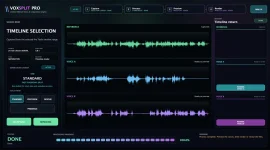
Dialogue isolation separates speech from competing sound, while speaker separation tries to recover individual voices when more than one person is talking. Diarization solves a third problem by marking who spoke when rather than rebuilding the audio itself. Those distinctions matter whenever your next step is editing, transcription, or repair.
The confusion is understandable because all three processes can make a messy conversation easier to work with. Their outputs are different, though, and picking the wrong one can leave you with a cleaner recording that is still impossible to edit the way you intended. Start with the deliverable instead of the tool name.
A dialogue editor who needs to lower one interruption needs independent voice audio. A producer preparing a transcript may only need speaker labels and timestamps. Someone fighting traffic or music under a single actor usually needs dialogue isolation instead.
Speaker separation goes further by estimating separate voice signals from the mixture. The goal is not simply cleaner dialogue but independent control over the people inside it. A usable result lets you lower, mute, repair, or process one speaker without applying the same move to the other.
Diarization leaves the underlying recording intact. It creates speaker activity information such as Speaker 1 speaking during one interval and Speaker 2 during another, often alongside transcription. An overlap-aware system can mark two people as active at the same time, but those labels alone do not remove either voice from the shared waveform.
This difference becomes obvious in a one-second interruption. A diarization system may correctly mark both speakers during that second, yet copying the interval into either person's track would still copy both voices. Separation has to estimate the individual signals before you gain genuine audio control.
Overlap makes speaker attribution harder as well. Two voices occupy the same time span, so a system built around one active speaker at a time can miss speech, assign the interval incorrectly, or collapse both people into one turn. Modern overlap-aware systems can represent simultaneous speakers, but representation still is not reconstruction.
A separation, diarization, and recognition pipeline can place separation before speaker labeling precisely because cleaner individual streams reduce the overlap problem presented to later stages. The stages remain distinct even when one application bundles them together. Combining them does not turn diarization into source separation.
Product language can muddy this further. Some transcription software uses "speaker separation" to describe speaker labeling, while audio tools may use the same phrase for actual stem generation. Look at the exported result before trusting the label because separate timestamps, separate transcript turns, and separate audio files are three different things.
Use independently editable speaker audio when two voices are baked into the same recording, and one must be changed without dragging the other along. The overlap itself is the clue. EQ, denoising, transcript labels, and timeline cuts cannot give you true control over one person during samples that also contain another person.
Use diarization when the valuable output is structure. Speaker-labeled transcripts, searchable interviews, meeting analysis, subtitle preparation, and navigation through long conversations benefit from knowing when each person talks even if nobody needs a new audio stem. Separation can be unnecessary work in those cases.
Some jobs need all three. A noisy panel recording may first need dialogue isolation, then speaker separation for dense crosstalk, followed by diarization or transcription for searchable speaker labels. Keep each stage tied to a specific problem, because piling processing onto audio without a reason increases the chance of artifacts and makes mistakes harder to trace.
When a job needs more than one process, preserve the original and render each stage separately. A diarization mistake changes metadata, while a failed separation changes the audio itself. Keeping those outputs distinct lets you rerun one stage without rebuilding the chain.
The confusion is understandable because all three processes can make a messy conversation easier to work with. Their outputs are different, though, and picking the wrong one can leave you with a cleaner recording that is still impossible to edit the way you intended. Start with the deliverable instead of the tool name.
A dialogue editor who needs to lower one interruption needs independent voice audio. A producer preparing a transcript may only need speaker labels and timestamps. Someone fighting traffic or music under a single actor usually needs dialogue isolation instead.
The output tells you which problem was solved
Dialogue isolation treats speech as the material to keep while reducing competing material such as music, ambience, mechanical noise, or other non-speech sound. It can produce a much cleaner dialogue stem without deciding which person owns each word. When two actors speak together, both voices can survive because both belong to the speech category.Speaker separation goes further by estimating separate voice signals from the mixture. The goal is not simply cleaner dialogue but independent control over the people inside it. A usable result lets you lower, mute, repair, or process one speaker without applying the same move to the other.
Diarization leaves the underlying recording intact. It creates speaker activity information such as Speaker 1 speaking during one interval and Speaker 2 during another, often alongside transcription. An overlap-aware system can mark two people as active at the same time, but those labels alone do not remove either voice from the shared waveform.
This difference becomes obvious in a one-second interruption. A diarization system may correctly mark both speakers during that second, yet copying the interval into either person's track would still copy both voices. Separation has to estimate the individual signals before you gain genuine audio control.
Overlap exposes the limits of speaker labels
Diarization works especially well as an organizational layer for interviews, meetings, podcasts, and transcripts because it answers who spoke when. It does not necessarily identify a real person by name, and a label such as Speaker 2 is usually an assignment within the recording rather than proof of identity. For editing, the important limitation is simpler because a timestamp is metadata, not an isolated stem.Overlap makes speaker attribution harder as well. Two voices occupy the same time span, so a system built around one active speaker at a time can miss speech, assign the interval incorrectly, or collapse both people into one turn. Modern overlap-aware systems can represent simultaneous speakers, but representation still is not reconstruction.
A separation, diarization, and recognition pipeline can place separation before speaker labeling precisely because cleaner individual streams reduce the overlap problem presented to later stages. The stages remain distinct even when one application bundles them together. Combining them does not turn diarization into source separation.
Product language can muddy this further. Some transcription software uses "speaker separation" to describe speaker labeling, while audio tools may use the same phrase for actual stem generation. Look at the exported result before trusting the label because separate timestamps, separate transcript turns, and separate audio files are three different things.
Choose the process from the edit you need
Use dialogue isolation when the person is already the right person and the problem sits around the voice. Traffic, music, crowd bed, wind, or general production noise can all compete with dialogue without creating a second speaker-editing problem. You want the dialogue cleaner, not divided by identity.Use independently editable speaker audio when two voices are baked into the same recording, and one must be changed without dragging the other along. The overlap itself is the clue. EQ, denoising, transcript labels, and timeline cuts cannot give you true control over one person during samples that also contain another person.
Use diarization when the valuable output is structure. Speaker-labeled transcripts, searchable interviews, meeting analysis, subtitle preparation, and navigation through long conversations benefit from knowing when each person talks even if nobody needs a new audio stem. Separation can be unnecessary work in those cases.
Some jobs need all three. A noisy panel recording may first need dialogue isolation, then speaker separation for dense crosstalk, followed by diarization or transcription for searchable speaker labels. Keep each stage tied to a specific problem, because piling processing onto audio without a reason increases the chance of artifacts and makes mistakes harder to trace.
When a job needs more than one process, preserve the original and render each stage separately. A diarization mistake changes metadata, while a failed separation changes the audio itself. Keeping those outputs distinct lets you rerun one stage without rebuilding the chain.