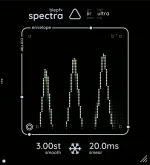
blepfx Spectra can shift its extracted spectral envelope by minus 24 to plus 24 semitones without simply transposing the incoming note. Its four-octave range is wide enough to move from subtle vocal resizing into deliberately synthetic territory.
Pitch and formant controls are easy to lump together because both can make a sound feel higher or lower. They act on different information. Pitch moves the harmonic spacing and fundamental, while formant shifting moves the broad resonant shape wrapped around those harmonics.
Spectra is useful here because its formant control sits inside an envelope-transfer system rather than a basic pitch shifter. You are moving the estimated envelope itself, and the Smooth control changes how detailed that estimate is before the shift happens.
Move the formants upward while leaving pitch alone, and the voice can feel smaller or lighter without changing the musical note. Move them downward and the same performance can gain a broader, heavier character. Extreme settings stop sounding like plausible anatomy and become sound design.
This is why Spectra’s four-octave formant range should not be treated like another transpose knob. A 12-semitone formant move does not mean the source has moved an octave in the melodic sense. The envelope has been displaced while the underlying harmonic pattern can remain where it was.
The distinction becomes easier to hear on sustained vowels, reeds, brass, and harmonically rich synth leads. Drums can respond too, but speech-like material exposes the effect quickly because resonant peaks already carry so much recognizable information.
More smoothing produces a broader contour. Small resonances and narrow spectral wrinkles are less likely to be dragged around as part of the formant shift, so the result can feel calmer and less metallic. This is often useful when the goal is believable vocal reshaping rather than an obvious effect.
Lower smoothing preserves a more detailed envelope. Once that detailed shape is shifted, closely spaced peaks and dips move with it, which can create sharper coloration and phasey motion. It is not necessarily worse. For basses, growls, talking synths, and processed vocals, the extra artificial edge may be the point.
The frequency-shifted vowel experiment also found that moving the spectral envelope can reduce vowel-identification accuracy as the shift becomes more extreme. The useful production lesson is simple. Large formant moves alter more than generic brightness because they disturb spectral relationships listeners use to recognize vocal character.
High notes are a good stress test. Widely spaced harmonics sample the spectral envelope less densely, so extreme formant movement can become less convincing or more obviously processed. A lower or denser source often gives the algorithm more spectral material to work with.
Spectra’s Smooth control becomes especially useful here. If a large upward shift turns brittle, adding smoothing can stop tiny spectral features from being moved so aggressively. If a downward shift becomes dull and anonymous, reducing Smooth can restore some of the source-specific detail.
Sidechain material changes the equation again because Spectra can borrow an envelope from one signal while using harmonic content from another. A vocal envelope placed over a dense synth carrier can remain legible at settings where the original voice alone starts sounding thin. A sparse carrier may do the opposite and expose gaps immediately.
Formant shifting works best when you judge character before loudness or novelty. Start near zero, move until the source clearly changes identity, then decide whether Smooth should hide the processing or expose it. Four octaves are available, but the interesting range often begins long before the control reaches either end. Small moves deserve careful listening because a few semitones can change apparent size and identity without announcing the processing itself.
Pitch and formant controls are easy to lump together because both can make a sound feel higher or lower. They act on different information. Pitch moves the harmonic spacing and fundamental, while formant shifting moves the broad resonant shape wrapped around those harmonics.
Spectra is useful here because its formant control sits inside an envelope-transfer system rather than a basic pitch shifter. You are moving the estimated envelope itself, and the Smooth control changes how detailed that estimate is before the shift happens.
Formants carry character while pitch carries the note
A sung vowel keeps its identity because energy gathers around resonant regions in the spectrum. Those peaks are formants, and their placement contributes heavily to whether a voice reads as dark, bright, small, large, nasal, open, or hollow.Move the formants upward while leaving pitch alone, and the voice can feel smaller or lighter without changing the musical note. Move them downward and the same performance can gain a broader, heavier character. Extreme settings stop sounding like plausible anatomy and become sound design.
This is why Spectra’s four-octave formant range should not be treated like another transpose knob. A 12-semitone formant move does not mean the source has moved an octave in the melodic sense. The envelope has been displaced while the underlying harmonic pattern can remain where it was.
The distinction becomes easier to hear on sustained vowels, reeds, brass, and harmonically rich synth leads. Drums can respond too, but speech-like material exposes the effect quickly because resonant peaks already carry so much recognizable information.
Smooth decides whether the shift feels natural or synthetic
blepfx says Spectra can move from more natural or subtle formant shifting into synthetic, phaser-like territory depending on Smooth. The reason is practical. Smoothing decides how much fine spectral structure gets treated as part of the envelope instead of remaining with the harmonic detail.More smoothing produces a broader contour. Small resonances and narrow spectral wrinkles are less likely to be dragged around as part of the formant shift, so the result can feel calmer and less metallic. This is often useful when the goal is believable vocal reshaping rather than an obvious effect.
Lower smoothing preserves a more detailed envelope. Once that detailed shape is shifted, closely spaced peaks and dips move with it, which can create sharper coloration and phasey motion. It is not necessarily worse. For basses, growls, talking synths, and processed vocals, the extra artificial edge may be the point.
The frequency-shifted vowel experiment also found that moving the spectral envelope can reduce vowel-identification accuracy as the shift becomes more extreme. The useful production lesson is simple. Large formant moves alter more than generic brightness because they disturb spectral relationships listeners use to recognize vocal character.
Extreme shifts expose the source material
A formant shifter still depends on the harmonics available underneath the envelope. Rich material gives the shifted contour plenty of partials to emphasize or suppress. Sparse tones can leave parts of the new envelope with little useful energy to shape.High notes are a good stress test. Widely spaced harmonics sample the spectral envelope less densely, so extreme formant movement can become less convincing or more obviously processed. A lower or denser source often gives the algorithm more spectral material to work with.
Spectra’s Smooth control becomes especially useful here. If a large upward shift turns brittle, adding smoothing can stop tiny spectral features from being moved so aggressively. If a downward shift becomes dull and anonymous, reducing Smooth can restore some of the source-specific detail.
Sidechain material changes the equation again because Spectra can borrow an envelope from one signal while using harmonic content from another. A vocal envelope placed over a dense synth carrier can remain legible at settings where the original voice alone starts sounding thin. A sparse carrier may do the opposite and expose gaps immediately.
Formant shifting works best when you judge character before loudness or novelty. Start near zero, move until the source clearly changes identity, then decide whether Smooth should hide the processing or expose it. Four octaves are available, but the interesting range often begins long before the control reaches either end. Small moves deserve careful listening because a few semitones can change apparent size and identity without announcing the processing itself.