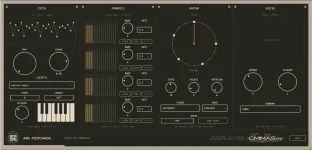
AMI-Polychaos reads one chaotic trajectory with four heads, and SPREAD controls how far those heads lag behind one another. STAGGER works on a different layer. It rotates each voice's Euclidean rhythm, changing where attacks land rather than how far apart the reading heads sit.
Both controls can make the four voices feel less locked together, which is why they are easy to confuse during a quick demo. The mechanism is different, and treating them as interchangeable makes the plug-in harder to steer. The AMI-Polychaos four-voice counterpoint engine uses SPREAD for separation along the chaotic orbit and STAGGER for separation in rhythmic placement.
SPREAD at zero keeps the four heads together on the same point of the orbit. Raise it, and each head reads the shared trajectory from a different position, so the melodic lines begin to diverge while still coming from the same underlying process. You are not adding four unrelated random generators, just widening the distance between four readings of one sequence.
A Euclidean pattern uses a set number of onsets across a set number of steps, and research on evenly distributed Euclidean rhythm onsets describes how those onsets can be spread as evenly as possible. Rotation changes where the pattern begins, not how many onsets it contains. STAGGER therefore changes rhythmic placement rather than acting as a basic density control.
Short plucks expose the difference fast. If several voices attack together, raising SPREAD can give those attacks different notes while leaving the rhythmic pileup in place. Raising STAGGER attacks the timing relationship directly, so the voices can enter at different moments even when their reading heads remain fairly close.
This is also why a low-SPREAD, higher-STAGGER setting can work well on mallets, percussion, short synth envelopes, and other sounds with obvious transients. The rhythm gets more interlocked without demanding four strongly independent melodic contours. You keep a clearer sense of shared pitch movement while the attacks stop arriving as one thick block.
Sustained sounds often make this balance easier to hear. Pads, strings, and slower envelopes do not rely on every onset being sharply exposed, so wider SPREAD can create movement inside the harmony without making the rhythmic surface constantly twitch. A restrained STAGGER setting leaves enough shared timing for the four parts to feel connected.
The reverse setup serves a different job. Lower SPREAD with stronger STAGGER keeps the trajectory positions closer while spreading attacks around the cycle, which can suit parts where groove matters more than four clearly independent melodies. Neither control is a stronger version of the other, and pushing the wrong one can fix the wrong problem.
Use the same chord while comparing them. Start with SPREAD near zero and move STAGGER while everything else stays still, then reset STAGGER and open SPREAD instead. Keeping the chaotic map, instrument, harmony mode, and incoming notes unchanged makes the contrast much easier to hear.
Busy patches exaggerate the problem. Long releases can smear staggered attacks together, while sharp transients make small offsets feel more dramatic, so the instrument can hide what the generator is doing. Shorten the release or use a plain sound before deciding the control settings are wrong.
Treat density separately from rotation. STAGGER can redistribute attacks around the cycle, but rotation alone does not reduce the number of onsets in a Euclidean pattern. If the passage still feels packed after the voices are staggered, look at note duration, pulse density, velocity behavior, tempo, or the receiving instrument's envelope rather than expecting more rotation to create space.
Both controls can make the four voices feel less locked together, which is why they are easy to confuse during a quick demo. The mechanism is different, and treating them as interchangeable makes the plug-in harder to steer. The AMI-Polychaos four-voice counterpoint engine uses SPREAD for separation along the chaotic orbit and STAGGER for separation in rhythmic placement.
SPREAD at zero keeps the four heads together on the same point of the orbit. Raise it, and each head reads the shared trajectory from a different position, so the melodic lines begin to diverge while still coming from the same underlying process. You are not adding four unrelated random generators, just widening the distance between four readings of one sequence.
Low SPREAD lets STAGGER handle the timing
Keep SPREAD low, and the voices retain a stronger connection in their melodic movement. Raising STAGGER then rotates the individual Euclidean patterns, pushing attacks onto different parts of the cycle without forcing the reading heads farther apart. You can separate the entries in time while keeping the pitch behavior relatively close.A Euclidean pattern uses a set number of onsets across a set number of steps, and research on evenly distributed Euclidean rhythm onsets describes how those onsets can be spread as evenly as possible. Rotation changes where the pattern begins, not how many onsets it contains. STAGGER therefore changes rhythmic placement rather than acting as a basic density control.
Short plucks expose the difference fast. If several voices attack together, raising SPREAD can give those attacks different notes while leaving the rhythmic pileup in place. Raising STAGGER attacks the timing relationship directly, so the voices can enter at different moments even when their reading heads remain fairly close.
This is also why a low-SPREAD, higher-STAGGER setting can work well on mallets, percussion, short synth envelopes, and other sounds with obvious transients. The rhythm gets more interlocked without demanding four strongly independent melodic contours. You keep a clearer sense of shared pitch movement while the attacks stop arriving as one thick block.
Higher SPREAD makes the orbit do more work
Raise SPREAD and the four heads sit farther apart along the shared chaotic trajectory. Each voice then reads a more separated moment of the same orbit, so the pitch contours have more room to differ. Keep STAGGER modest, and most of the perceived independence comes from the melodic lag rather than from heavily rotated attack patterns.Sustained sounds often make this balance easier to hear. Pads, strings, and slower envelopes do not rely on every onset being sharply exposed, so wider SPREAD can create movement inside the harmony without making the rhythmic surface constantly twitch. A restrained STAGGER setting leaves enough shared timing for the four parts to feel connected.
The reverse setup serves a different job. Lower SPREAD with stronger STAGGER keeps the trajectory positions closer while spreading attacks around the cycle, which can suit parts where groove matters more than four clearly independent melodies. Neither control is a stronger version of the other, and pushing the wrong one can fix the wrong problem.
Use the same chord while comparing them. Start with SPREAD near zero and move STAGGER while everything else stays still, then reset STAGGER and open SPREAD instead. Keeping the chaotic map, instrument, harmony mode, and incoming notes unchanged makes the contrast much easier to hear.
High settings can make the relationship harder to hear
Opening SPREAD and STAGGER together gives pitch position and rhythmic placement more room to diverge at the same time. The four voices can become easier to distinguish individually, but the shared source can become harder to perceive because fewer events reinforce one another in either dimension. More separation is not automatically cleaner.Busy patches exaggerate the problem. Long releases can smear staggered attacks together, while sharp transients make small offsets feel more dramatic, so the instrument can hide what the generator is doing. Shorten the release or use a plain sound before deciding the control settings are wrong.
Treat density separately from rotation. STAGGER can redistribute attacks around the cycle, but rotation alone does not reduce the number of onsets in a Euclidean pattern. If the passage still feels packed after the voices are staggered, look at note duration, pulse density, velocity behavior, tempo, or the receiving instrument's envelope rather than expecting more rotation to create space.