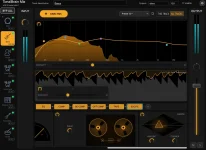
TonalBrain analyzes up to 24 key tracks together, while Neutron 5 builds its Mix Assistant processing around individual tracks or buses. Both can speed up a mix, but they hand you control in very different places. Choosing between them starts with deciding whether you want session-level decisions first or a deeper toolbox on each channel.
The TonalBrain whole-session mixing approach treats interaction between tracks as the starting problem. One analysis can consider kick, bass, vocal, drums, and main instruments together before TonalBrain builds editable processing across those channels. Neutron 5 approaches the session through a broader collection of tools, with Mix Assistant shaping tracks individually and Relay plus Visual Mixer handling communication and balance across the mix.
Neither workflow makes the other redundant. TonalBrain is more concentrated, while Neutron 5 gives you more ways to leave the automated path and start mixing manually.
This design matters when your main frustration is getting a crowded session into shape quickly. Instead of opening a separate assistant on every channel and building a chain one source at a time, you give TonalBrain a group of musical relationships to judge. Its four section snapshots can also expose the system to contrasting parts of the arrangement before it settles on one coherent result.
The idea fits the broader field of cross-adaptive multitrack audio processing, where processing decisions can depend on relationships between several simultaneous sources. TonalBrain is its own proprietary implementation, so the paper does not describe its algorithm. The useful connection is architectural, because session-aware processing solves a different problem from analyzing one channel in isolation.
Mix Assistant is only one entrance into that system. You can let it analyze an individual source, accept a suggested chain, use the simplified intent controls, then open Detailed View and change the underlying module settings yourself. A producer who enjoys interrogating every compressor mode, crossover, clipping band, or masking decision gets considerably more room to work.
Whole-session behavior exists, but through a different route. Relay enables inter-plugin communication, while Visual Mixer can see participating tracks and provide a central place for level, pan, and width decisions. In practice, Neutron separates track treatment from session balancing more explicitly than TonalBrain does.
This difference shows up when an automated suggestion misses your intention. TonalBrain lets you edit the processing it generated, but Neutron 5 gives you ten full processing modules plus standalone component versions. If the mix needs manual phase correction, multiband clipping, upward compression, surgical unmasking, or transient-focused processing, Neutron already has dedicated tools waiting inside the same suite.
Neutron 5 suits a different kind of session. Its Mix Assistant can get individual sources moving quickly, but the real advantage of the full version appears when you keep working after the suggestion. Visual Mixer, Relay, Unmask, Phase, Clipper, Density, and the detailed module controls turn it into a general mixing environment rather than one automated decision layer.
Both currently support AAX, AU, and VST3 hosts, so plugin format is unlikely to settle the choice for most modern DAWs. Workflow is the sharper divider. TonalBrain tries to reduce the number of technical mix decisions you make across connected tracks, while Neutron 5 gives you assistance without asking you to give up the deeper mechanics of those decisions.
A fast songwriter with a dense arrangement may value TonalBrain's concentrated session pass more than another rack of processors. An engineer who wants AI to provide a starting point, then expects to reshape every detail, will probably get more mileage from Neutron 5. The products overlap around assisted mixing, but their center of gravity is different.
The TonalBrain whole-session mixing approach treats interaction between tracks as the starting problem. One analysis can consider kick, bass, vocal, drums, and main instruments together before TonalBrain builds editable processing across those channels. Neutron 5 approaches the session through a broader collection of tools, with Mix Assistant shaping tracks individually and Relay plus Visual Mixer handling communication and balance across the mix.
Neither workflow makes the other redundant. TonalBrain is more concentrated, while Neutron 5 gives you more ways to leave the automated path and start mixing manually.
TonalBrain makes the session the first decision
TonalBrain wants the important parts of the arrangement available at the same time. Its analysis looks for masking, dynamic collisions, and balance problems across the selected tracks, then applies processing such as EQ, compression, de-essing, stereo width, saturation, and excitation where it decides they are needed. You can edit, reorder, or remove those moves afterward.This design matters when your main frustration is getting a crowded session into shape quickly. Instead of opening a separate assistant on every channel and building a chain one source at a time, you give TonalBrain a group of musical relationships to judge. Its four section snapshots can also expose the system to contrasting parts of the arrangement before it settles on one coherent result.
The idea fits the broader field of cross-adaptive multitrack audio processing, where processing decisions can depend on relationships between several simultaneous sources. TonalBrain is its own proprietary implementation, so the paper does not describe its algorithm. The useful connection is architectural, because session-aware processing solves a different problem from analyzing one channel in isolation.
Neutron 5 gives you a deeper repair bench
Neutron 5 has a much wider processing vocabulary. The full suite includes EQ, compression, exciter, gate, transient shaping, Sculptor, Unmask, Clipper, Density, and Phase, with mid-side or transient-sustain modes available in several modules. Its mothership can hold a chain, while the component plugins can also be loaded separately.Mix Assistant is only one entrance into that system. You can let it analyze an individual source, accept a suggested chain, use the simplified intent controls, then open Detailed View and change the underlying module settings yourself. A producer who enjoys interrogating every compressor mode, crossover, clipping band, or masking decision gets considerably more room to work.
Whole-session behavior exists, but through a different route. Relay enables inter-plugin communication, while Visual Mixer can see participating tracks and provide a central place for level, pan, and width decisions. In practice, Neutron separates track treatment from session balancing more explicitly than TonalBrain does.
This difference shows up when an automated suggestion misses your intention. TonalBrain lets you edit the processing it generated, but Neutron 5 gives you ten full processing modules plus standalone component versions. If the mix needs manual phase correction, multiband clipping, upward compression, surgical unmasking, or transient-focused processing, Neutron already has dedicated tools waiting inside the same suite.
The better choice depends on where you want friction removed
TonalBrain suits the producer who wants the first major decision to happen across the song. Load the important channels, capture representative sections, run the analysis, then adjust what came back. Its pay-as-you-go credit model also means you are paying for analysis runs rather than buying a large permanent mixing suite upfront.Neutron 5 suits a different kind of session. Its Mix Assistant can get individual sources moving quickly, but the real advantage of the full version appears when you keep working after the suggestion. Visual Mixer, Relay, Unmask, Phase, Clipper, Density, and the detailed module controls turn it into a general mixing environment rather than one automated decision layer.
Both currently support AAX, AU, and VST3 hosts, so plugin format is unlikely to settle the choice for most modern DAWs. Workflow is the sharper divider. TonalBrain tries to reduce the number of technical mix decisions you make across connected tracks, while Neutron 5 gives you assistance without asking you to give up the deeper mechanics of those decisions.
A fast songwriter with a dense arrangement may value TonalBrain's concentrated session pass more than another rack of processors. An engineer who wants AI to provide a starting point, then expects to reshape every detail, will probably get more mileage from Neutron 5. The products overlap around assisted mixing, but their center of gravity is different.