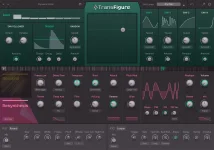
Transfigure provides eight main modulation sources, combining an envelope follower, random generator, separate X and Y outputs, and four multi-breakpoint envelopes. The XY pad is only two of those eight signals, even though it dominates the interface.
The launch of Transfigure modulation tools on iPad puts the pad front and center, but the deeper system is built around independent control signals. A parameter can receive several modulation sources with separate amounts, so one knob can move for more than one reason.
More unusually, Transfigure lets modulator controls become modulation targets themselves. One moving source can change the strength or behavior of another before the final signal reaches an effect or processor. It turns simple movement into a small control system.
Its Amount range reaches 200 percent, which helps with quiet or lightly varying material. High Attack values reduce fast modulation swings, while shorter settings catch peaks more readily. The underlying idea is established in audio-signal-driven sound synthesis, where features taken from live audio become control information rather than remaining only part of the audible signal.
The Trigger unit is related but does a different job. It creates discrete events when the signal crosses a threshold, while Decay lowers that threshold over time if the input is too quiet to cross it reliably. Delay can move the event a few milliseconds later.
Those triggers can restart the multi-breakpoint envelopes as well as control freeze behavior. A rhythmic source can therefore create its own modulation timing without MIDI notes or a fixed sequencer lane. The input supplies the event, while the envelope supplies the shape that follows.
The editor offers Point, Line, Step, Select, and Stretch modes. A grid can divide horizontal or vertical space from 2 through 32 steps, while Normalize, Flip, and Move functions reorganize a curve without redrawing it. Envelope presets are stored separately, making useful shapes reusable across patches.
The less obvious modes make the system much deeper. Envelope Follower mode takes the follower output and remaps it through the drawn envelope, so a smooth amplitude trace can become a hard threshold-like response. Sugar Bytes gives the example of output jumping to full only after the follower passes a chosen point.
X and Y can be processed the same way. An envelope can remain silent until the pad crosses a defined position, then output a different control value. Factory presets use this conditional mapping for actions such as bringing in freeze only after X or Y reaches a chosen region.
Random mode also passes the Random unit through an envelope shape instead of sending raw values directly to the target. The curve can compress, invert, gate, or reshape the random stream. Random movement becomes unpredictable within a response profile you designed.
Separate X and Y outputs also matter because they need not control the same destinations. X can increase spectral delay while Y changes filter drive, and either axis can alter the amount of an envelope moving something else. One gesture can change a sound parameter and the way another source reaches it.
Modulating a modulator is where the architecture earns its keep. Let an envelope follower control the amount of a slow multi-breakpoint envelope, then route that envelope to spectral delay or resynthesis pitch movement. Quiet passages keep the motion restrained, while louder passages open it up without changing the envelope’s timing.
For a controlled performance patch, keep X on the final modulation depth while the input envelope changes the movement underneath it. Your finger sets the ceiling, the audio decides how much energy reaches the control system, and the drawn envelope decides where that energy goes.
The launch of Transfigure modulation tools on iPad puts the pad front and center, but the deeper system is built around independent control signals. A parameter can receive several modulation sources with separate amounts, so one knob can move for more than one reason.
More unusually, Transfigure lets modulator controls become modulation targets themselves. One moving source can change the strength or behavior of another before the final signal reaches an effect or processor. It turns simple movement into a small control system.
Eight modulation sources sit behind the XY pad
The envelope follower turns incoming audio level into control movement, with Attack and Release deciding how quickly it reacts. You can follow the full signal or choose a frequency band first, letting a patch respond mainly to kicks, upper percussion, or another useful region.Its Amount range reaches 200 percent, which helps with quiet or lightly varying material. High Attack values reduce fast modulation swings, while shorter settings catch peaks more readily. The underlying idea is established in audio-signal-driven sound synthesis, where features taken from live audio become control information rather than remaining only part of the audible signal.
The Trigger unit is related but does a different job. It creates discrete events when the signal crosses a threshold, while Decay lowers that threshold over time if the input is too quiet to cross it reliably. Delay can move the event a few milliseconds later.
Those triggers can restart the multi-breakpoint envelopes as well as control freeze behavior. A rhythmic source can therefore create its own modulation timing without MIDI notes or a fixed sequencer lane. The input supplies the event, while the envelope supplies the shape that follows.
Multi-breakpoint envelopes reshape other modulators
Each of the four envelopes can behave like an LFO, step sequencer, one-shot shape, or transformer for another modulation source. Their editor uses anchor and control points instead of a fixed ADSR layout, so a curve can contain several rises, drops, plateaus, and bends.The editor offers Point, Line, Step, Select, and Stretch modes. A grid can divide horizontal or vertical space from 2 through 32 steps, while Normalize, Flip, and Move functions reorganize a curve without redrawing it. Envelope presets are stored separately, making useful shapes reusable across patches.
The less obvious modes make the system much deeper. Envelope Follower mode takes the follower output and remaps it through the drawn envelope, so a smooth amplitude trace can become a hard threshold-like response. Sugar Bytes gives the example of output jumping to full only after the follower passes a chosen point.
X and Y can be processed the same way. An envelope can remain silent until the pad crosses a defined position, then output a different control value. Factory presets use this conditional mapping for actions such as bringing in freeze only after X or Y reaches a chosen region.
Random mode also passes the Random unit through an envelope shape instead of sending raw values directly to the target. The curve can compress, invert, gate, or reshape the random stream. Random movement becomes unpredictable within a response profile you designed.
Nested modulation keeps complex patches controlled
The Random unit has several timing behaviors. It can generate values from the host clock, work in seconds, glide between clocked values, or create a new value whenever the Trigger unit fires. Trigger Glide keeps that event-driven behavior but moves gradually toward each new value.Separate X and Y outputs also matter because they need not control the same destinations. X can increase spectral delay while Y changes filter drive, and either axis can alter the amount of an envelope moving something else. One gesture can change a sound parameter and the way another source reaches it.
Modulating a modulator is where the architecture earns its keep. Let an envelope follower control the amount of a slow multi-breakpoint envelope, then route that envelope to spectral delay or resynthesis pitch movement. Quiet passages keep the motion restrained, while louder passages open it up without changing the envelope’s timing.
For a controlled performance patch, keep X on the final modulation depth while the input envelope changes the movement underneath it. Your finger sets the ceiling, the audio decides how much energy reaches the control system, and the drawn envelope decides where that energy goes.