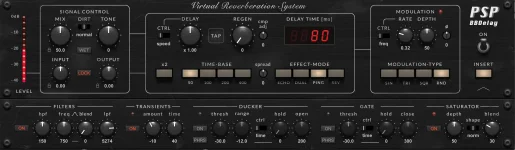
PSP BBDelay can attenuate or exaggerate the transient on every delayed repetition, while a separate Time control changes its duration and character. It is an unusual place to put this kind of control. Most delay advice tells you to soften the source before it reaches the echo, then live with whatever repeats come back.
BBDelay lets you leave the original hit alone and work on the delayed signal itself. The difference is useful on percussion, picked guitar, plucks, piano, and short synth stabs where the repeat can feel too much like a second performance. The PSP BBDelay repeat-shaping controls give you another option between turning the echo down and burying it under filtering.
Attack is part of the rhythm, not just the tone. A repeat with a hard front edge declares its timing clearly, while a softened one can sit behind the dry note even when both arrive at the same delay time.
Turn Amount clockwise, and the opposite happens. Repeats gain a more obvious attack, which can make a simple delay pattern read like an extra rhythmic layer instead of background space. A dull synth stab can throw little accents between the dry notes, and a rimshot delay can become part of the beat rather than a fading copy behind it.
This is where transient control earns its keep over basic wet-level adjustment. Lowering the delay return makes the entire repeat quieter, including its body and decay. Reducing attack changes the shape of the event, so you can make the front less competitive while keeping enough level behind it to hear the BBD color and feedback tail.
The principle behind separate attack and sustain envelope control is based on detecting fast and slow level behavior independently rather than treating the whole signal as one static gain block. BBDelay exposes a simpler musical interface, but the important listening idea survives. Attack can be altered without pretending volume and envelope shape are the same thing.
Short settings focus the processing closer to the front edge. This suits tight drums and plucks where the useful distinction lives in a brief click, crack, or pick noise. Longer settings let the processor reach further into the beginning, so the change can feel less like shaving a spike and more like redrawing the entrance of the repeat.
Not every transient-heavy source has the same envelope. A closed hi-hat gives you a tiny, abrupt event. A piano note has hammer attack followed by a body that develops immediately, while a picked guitar carries pick noise, string movement, and resonance through the same opening moment.
Use Time by ear against the source instead of treating one value as correct. If reducing Amount only makes the repeat feel oddly dented, the transient window may be too short for the sound. If the entire front of the echo seems to sag, pull Time back until the body regains its shape.
Try it on a vocal phrase with clear consonants. A normal bright delay can repeat every T, K, and S sharply enough to make the line feel cluttered even when the delay level is sensible. Backing off the delayed transients can leave the vowels and tonal body audible while making those repeated consonant attacks less insistent.
The reverse move is useful too. If a dark BBD setting has plenty of character but the repeats disappear once the arrangement fills up, a little positive Amount can restore rhythmic definition without opening the low-pass filter. You are changing the arrival shape instead of repainting the spectrum.
For a clean test, keep feedback low, bypass ducking and gating, and feed BBDelay a short percussive sound. Set the delay loud enough to hear one or two repeats clearly, sweep Amount from negative to positive, then adjust Time at each extreme. The timing never moves, yet the groove can feel looser, sharper, calmer, or more insistent purely because the front edge of each repeat has changed.
BBDelay lets you leave the original hit alone and work on the delayed signal itself. The difference is useful on percussion, picked guitar, plucks, piano, and short synth stabs where the repeat can feel too much like a second performance. The PSP BBDelay repeat-shaping controls give you another option between turning the echo down and burying it under filtering.
Attack is part of the rhythm, not just the tone. A repeat with a hard front edge declares its timing clearly, while a softened one can sit behind the dry note even when both arrive at the same delay time.
Repeat attack changes how busy the groove feels
Turn the Amount control counterclockwise, and BBDelay reduces transients on every repetition. The echo still lands on the same subdivision, but its leading edge becomes less pushy. On a bright eighth-note guitar delay, this can stop every repeat from competing with the next picked note without forcing you to make the whole wet signal dark.Turn Amount clockwise, and the opposite happens. Repeats gain a more obvious attack, which can make a simple delay pattern read like an extra rhythmic layer instead of background space. A dull synth stab can throw little accents between the dry notes, and a rimshot delay can become part of the beat rather than a fading copy behind it.
This is where transient control earns its keep over basic wet-level adjustment. Lowering the delay return makes the entire repeat quieter, including its body and decay. Reducing attack changes the shape of the event, so you can make the front less competitive while keeping enough level behind it to hear the BBD color and feedback tail.
The principle behind separate attack and sustain envelope control is based on detecting fast and slow level behavior independently rather than treating the whole signal as one static gain block. BBDelay exposes a simpler musical interface, but the important listening idea survives. Attack can be altered without pretending volume and envelope shape are the same thing.
The Time control decides what counts as the transient
Amount gets the obvious attention because it makes the repeat softer or sharper straight away. Time decides how the transient processor behaves over a longer or shorter slice of the delayed event. PSP describes it as the base time for transient control, affecting both duration and character.Short settings focus the processing closer to the front edge. This suits tight drums and plucks where the useful distinction lives in a brief click, crack, or pick noise. Longer settings let the processor reach further into the beginning, so the change can feel less like shaving a spike and more like redrawing the entrance of the repeat.
Not every transient-heavy source has the same envelope. A closed hi-hat gives you a tiny, abrupt event. A piano note has hammer attack followed by a body that develops immediately, while a picked guitar carries pick noise, string movement, and resonance through the same opening moment.
Use Time by ear against the source instead of treating one value as correct. If reducing Amount only makes the repeat feel oddly dented, the transient window may be too short for the sound. If the entire front of the echo seems to sag, pull Time back until the body regains its shape.
Transient shaping can separate echoes without EQ
Filtering is the usual fix when delay repeats crowd a mix. It works, but it changes frequency balance. Transient shaping can create separation while leaving the repeat brighter, which matters when the echo needs detail but should stop poking through the lead sound.Try it on a vocal phrase with clear consonants. A normal bright delay can repeat every T, K, and S sharply enough to make the line feel cluttered even when the delay level is sensible. Backing off the delayed transients can leave the vowels and tonal body audible while making those repeated consonant attacks less insistent.
The reverse move is useful too. If a dark BBD setting has plenty of character but the repeats disappear once the arrangement fills up, a little positive Amount can restore rhythmic definition without opening the low-pass filter. You are changing the arrival shape instead of repainting the spectrum.
For a clean test, keep feedback low, bypass ducking and gating, and feed BBDelay a short percussive sound. Set the delay loud enough to hear one or two repeats clearly, sweep Amount from negative to positive, then adjust Time at each extreme. The timing never moves, yet the groove can feel looser, sharper, calmer, or more insistent purely because the front edge of each repeat has changed.