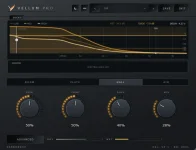
Vellum Pro can analyze an imported impulse response, measure its decay, predelay, and early reflections, then move its own reverb toward the closest available match. It does not simply load the file and play the captured response back through convolution.
The distinction changes what happens after the match. A convolution reverb normally treats the IR as the filter that creates the space, while Vellum Pro uses the IR as a target for parameter fitting, leaving you with an algorithmic reverb you can still reshape.
The useful part of Vellum Pro’s impulse-response matching feature is therefore not perfect cloning. It is the ability to borrow recognizable traits from a room, hall, chamber, or plate without locking every later decision to the original recording.
Matching software has to reduce all of that information to something its own reverb architecture can reproduce. Vellum Pro states that it measures decay, predelay, and early reflections, then sets itself to the closest match its engine can make.
This is parameter estimation rather than playback. The broader idea appears in room impulse-response matching with feedback delay networks, where features from a target response are used to configure a synthetic reverberator, and the remaining parameters are optimized toward the measured room.
The distinction matters because a fitted reverb stays editable in ways a raw capture does not. Once the starting point exists, you can shorten the tail, redraw frequency-dependent decay, change the source engine, alter the space, or push the result away from the measured room while keeping some of its original character.
This creates a harder matching problem than copying one global RT60 value. Two reverbs can decay for roughly the same length yet feel unrelated because their opening reflections arrive in different patterns or because the early section has a different spectral shape.
Work on room-response matching has shown why this matters. Systems that combine a synthetic late reverb with a short segment of the target’s early response can improve the approximation, while difficult targets can still retain differences in spectrum and clarity even when the broad decay behavior is close.
Vellum Pro takes a more practical plugin approach by measuring early reflections alongside decay and predelay. The result should be read as a fitted interpretation of the imported response, not as a sample-accurate duplicate of every reflection and resonance contained in the file.
A useful test is to compare the first half-second before judging the tail. If the apparent distance, initial room shape, or attack behavior feels wrong, matching the overall decay more closely may not fix the part your ear is actually rejecting.
An imported IR might contain reflection geometry, resonances, modulation, nonlinear artifacts, unusual frequency decay, or processing that does not map cleanly onto the controls of the destination reverb. Forcing a numerical answer in those cases could produce settings that look precise while sounding unrelated.
The same limit appears in academic matching systems. Optimizing an algorithmic reverb can reduce measurable error substantially, yet the remaining differences depend on what the chosen architecture and comparison metric are capable of representing.
Vellum Pro’s refusal behavior makes the limitation visible instead of hiding it behind a confident preset name. A successful result means the engine found a nearby setting within its own design, not that the imported room has somehow been converted losslessly into another form.
This makes IR matching most useful as a starting-point generator. Load a space whose early feel and decay you already like, let the plugin find a workable approximation, then judge the result as an editable reverb rather than grading it on whether every microscopic feature survived the translation.
The distinction changes what happens after the match. A convolution reverb normally treats the IR as the filter that creates the space, while Vellum Pro uses the IR as a target for parameter fitting, leaving you with an algorithmic reverb you can still reshape.
The useful part of Vellum Pro’s impulse-response matching feature is therefore not perfect cloning. It is the ability to borrow recognizable traits from a room, hall, chamber, or plate without locking every later decision to the original recording.
IR matching turns a recording into control settings
An impulse response contains far more than one reverb-time number. Its opening milliseconds describe the direct arrival and early reflection pattern, while the later section carries the evolving decay, spectral balance, density, and other traits that make one captured space behave differently from another.Matching software has to reduce all of that information to something its own reverb architecture can reproduce. Vellum Pro states that it measures decay, predelay, and early reflections, then sets itself to the closest match its engine can make.
This is parameter estimation rather than playback. The broader idea appears in room impulse-response matching with feedback delay networks, where features from a target response are used to configure a synthetic reverberator, and the remaining parameters are optimized toward the measured room.
The distinction matters because a fitted reverb stays editable in ways a raw capture does not. Once the starting point exists, you can shorten the tail, redraw frequency-dependent decay, change the source engine, alter the space, or push the result away from the measured room while keeping some of its original character.
Early reflections can decide whether a match feels convincing
Long decay gets most of the attention because it is easy to hear and easy to describe, but the first part of a room response carries strong spatial information. Reflection timing and level near the beginning help establish apparent distance, enclosure, and how quickly the reverberant field seems to form around the source.This creates a harder matching problem than copying one global RT60 value. Two reverbs can decay for roughly the same length yet feel unrelated because their opening reflections arrive in different patterns or because the early section has a different spectral shape.
Work on room-response matching has shown why this matters. Systems that combine a synthetic late reverb with a short segment of the target’s early response can improve the approximation, while difficult targets can still retain differences in spectrum and clarity even when the broad decay behavior is close.
Vellum Pro takes a more practical plugin approach by measuring early reflections alongside decay and predelay. The result should be read as a fitted interpretation of the imported response, not as a sample-accurate duplicate of every reflection and resonance contained in the file.
A useful test is to compare the first half-second before judging the tail. If the apparent distance, initial room shape, or attack behavior feels wrong, matching the overall decay more closely may not fix the part your ear is actually rejecting.
A failed match can be more useful than a bad imitation
CarbonDSP says Vellum Pro can refuse an impulse response when the file describes something its engine cannot reproduce. The boundary is important because algorithmic matching always operates inside the available parameter space, and some target responses sit outside it.An imported IR might contain reflection geometry, resonances, modulation, nonlinear artifacts, unusual frequency decay, or processing that does not map cleanly onto the controls of the destination reverb. Forcing a numerical answer in those cases could produce settings that look precise while sounding unrelated.
The same limit appears in academic matching systems. Optimizing an algorithmic reverb can reduce measurable error substantially, yet the remaining differences depend on what the chosen architecture and comparison metric are capable of representing.
Vellum Pro’s refusal behavior makes the limitation visible instead of hiding it behind a confident preset name. A successful result means the engine found a nearby setting within its own design, not that the imported room has somehow been converted losslessly into another form.
This makes IR matching most useful as a starting-point generator. Load a space whose early feel and decay you already like, let the plugin find a workable approximation, then judge the result as an editable reverb rather than grading it on whether every microscopic feature survived the translation.