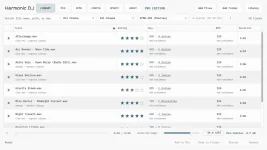
Harmonic DJ can keep the longest compatible route it finds when generation cannot fill every requested position without breaking its active constraints. The target track count stays in place, so another generation can still aim for the full length after you loosen something.
A shorter result does not mean the search simply ran out of patience. Harmonic DJ is trying to connect unique, eligible tracks through directed transitions while also respecting BPM policy, allowed keys, locks, exclusions, groups, and any start-to-end key requirement you have enabled.
The Harmonic DJ route generation behavior becomes easier to troubleshoot once you separate hard eligibility from preference. A five-star track cannot rescue a route if the track fails a rule that makes it ineligible in the first place.
Allowed Keys can narrow things again. Both the effective incoming and outgoing keys of a track have to use an enabled root and mode, including any transposition applied by pitch-shifted playback. A saved Gem or locked position does not give a newly generated track permission to ignore those global membership rules.
Transition profiles add another layer between individually eligible tracks. A focused profile may accept far fewer directed edges than the General Purpose profile, especially in a small library. Plenty of valid songs can therefore exist while too few valid connections exist to assemble the requested route.
Start and end requirements can tighten the graph further. Requiring every selected track to keep the same key between its two analyzed halves, or requiring every track to change, removes candidates before their neighboring transitions are even compared.
Exclusions are deliberately strict too. Blocking a track from one position, a segment, or the whole Mix reduces the routes available to generation. Several reasonable exclusions can become restrictive when combined with narrow BPM and harmonic settings.
The trade-off appears when two locked regions cannot be connected under the current rules. Harmonic DJ must preserve every lock while filling the open positions, so one awkward boundary can eliminate otherwise attractive tracks from consideration. If no compatible progress can preserve those locks, the previous tracklist stays unchanged.
Segment regeneration has the same basic pressure. Locked tracks around the segment act as fixed boundaries, and every newly chosen track inside the opening still has to create a legal route between them. Widening the library will not help much if the boundary itself conflicts with your transition profile or key restrictions.
Personal ratings sit much lower in the decision order. Five stars can favor one eligible route over another, while one or two stars can make a track less desirable. Ratings cannot override BPM limits, Allowed Keys, exclusions, a stricter saved-Gem rule, or transition eligibility.
The broader optimization literature includes bottleneck traveling-salesman methods that minimize the worst edge in a complete route. Harmonic DJ uses its own musical ranking rules, with the weakest accepted transition considered before the stronger ones and track ratings kept as a bounded preference.
Search Quality changes how long the software keeps working toward the best legal route, not what counts as legal. Auto can return the best complete route found within its search budget when proving the optimum would take longer, while Optimal continues until the best route is proven or you cancel it.
Harmonic detail is softer still. It reranks transitions that already passed the active relation rules by using fuller incoming and outgoing harmonic evidence. It cannot turn a rejected edge into an accepted one.
A partial route therefore points you toward constraints before ratings or harmonic detail. Check whether enough ready tracks share the BPM policy, whether your enabled roots and modes leave usable options, whether the transition profile is too focused, and whether locks or exclusions have boxed generation into a dead end.
One change at a time works better than flattening every rule at once. Loosening the most restrictive setting preserves the rest of your planning logic and makes the next generated route easier to interpret.
A shorter result does not mean the search simply ran out of patience. Harmonic DJ is trying to connect unique, eligible tracks through directed transitions while also respecting BPM policy, allowed keys, locks, exclusions, groups, and any start-to-end key requirement you have enabled.
The Harmonic DJ route generation behavior becomes easier to troubleshoot once you separate hard eligibility from preference. A five-star track cannot rescue a route if the track fails a rule that makes it ineligible in the first place.
Hard constraints can shrink the candidate pool quickly
Same Mix BPM is a gate, not a score. A track either matches the rounded Mix BPM under that strategy or it does not enter the candidate pool. Allowing pitch-shifted tracks widens the pool only when the required playback ratio lands close enough to a permitted integer-semitone shift.Allowed Keys can narrow things again. Both the effective incoming and outgoing keys of a track have to use an enabled root and mode, including any transposition applied by pitch-shifted playback. A saved Gem or locked position does not give a newly generated track permission to ignore those global membership rules.
Transition profiles add another layer between individually eligible tracks. A focused profile may accept far fewer directed edges than the General Purpose profile, especially in a small library. Plenty of valid songs can therefore exist while too few valid connections exist to assemble the requested route.
Start and end requirements can tighten the graph further. Requiring every selected track to keep the same key between its two analyzed halves, or requiring every track to change, removes candidates before their neighboring transitions are even compared.
Exclusions are deliberately strict too. Blocking a track from one position, a segment, or the whole Mix reduces the routes available to generation. Several reasonable exclusions can become restrictive when combined with narrow BPM and harmonic settings.
Locked tracks can make the missing connection impossible
Locks protect authored positions during regeneration. They are useful precisely because the generator is not allowed to throw away a transition you already trust just to make the rest of the route easier.The trade-off appears when two locked regions cannot be connected under the current rules. Harmonic DJ must preserve every lock while filling the open positions, so one awkward boundary can eliminate otherwise attractive tracks from consideration. If no compatible progress can preserve those locks, the previous tracklist stays unchanged.
Segment regeneration has the same basic pressure. Locked tracks around the segment act as fixed boundaries, and every newly chosen track inside the opening still has to create a legal route between them. Widening the library will not help much if the boundary itself conflicts with your transition profile or key restrictions.
Personal ratings sit much lower in the decision order. Five stars can favor one eligible route over another, while one or two stars can make a track less desirable. Ratings cannot override BPM limits, Allowed Keys, exclusions, a stricter saved-Gem rule, or transition eligibility.
Harmonic DJ protects the weakest accepted transition
Once complete routes are legal, Harmonic DJ compares transition quality from the weakest accepted connection upward. Several excellent pairings do not simply compensate for one poor connection buried in the middle of the set.The broader optimization literature includes bottleneck traveling-salesman methods that minimize the worst edge in a complete route. Harmonic DJ uses its own musical ranking rules, with the weakest accepted transition considered before the stronger ones and track ratings kept as a bounded preference.
Search Quality changes how long the software keeps working toward the best legal route, not what counts as legal. Auto can return the best complete route found within its search budget when proving the optimum would take longer, while Optimal continues until the best route is proven or you cancel it.
Harmonic detail is softer still. It reranks transitions that already passed the active relation rules by using fuller incoming and outgoing harmonic evidence. It cannot turn a rejected edge into an accepted one.
A partial route therefore points you toward constraints before ratings or harmonic detail. Check whether enough ready tracks share the BPM policy, whether your enabled roots and modes leave usable options, whether the transition profile is too focused, and whether locks or exclusions have boxed generation into a dead end.
One change at a time works better than flattening every rule at once. Loosening the most restrictive setting preserves the rest of your planning logic and makes the next generated route easier to interpret.