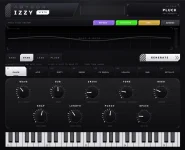
IZZY Synth 0.1.0 ships as a 64-bit Windows VST3 plugin and a separate standalone executable for Windows 10 or later. Both versions give you the same basic instrument idea, including eight patch slots, four sound roles, nine macro controls, and the built-in keyboard.
The free IZZY Synth release therefore gives you two ways to reach the synth rather than two different synths. The useful choice is about where you are working, because one version lives inside a host while the other opens as its own Windows application.
For quick sound hunting, the standalone build removes the DAW from the session entirely. Once a part belongs to an arrangement, VST3 becomes more practical because your MIDI clips, track structure, and project live in the same place as the instrument.
IZZY also behaves slightly differently here when checking for updates. Version 0.1.0 performs an automatic update check roughly three seconds after the standalone app opens, while the interface still provides a manual update control. Small detail, but it matters if you mostly use the synth outside a DAW and rarely visit the download page.
Standalone does not automatically mean lower playing latency. Delay depends on the wider audio path, and musicians can be sensitive to the gap between an action and the sound it produces. One controlled study found lower delay-detection thresholds in musicians than non-musicians, which makes auditory-motor delay sensitivity in musicians relevant when a keyboard feels disconnected from the sound.
If IZZY feels sluggish in standalone mode, changing to VST3 is not a reliable fix by itself. The DAW may use a different audio device, driver, or buffer configuration, so compare the actual setups rather than assuming one format is inherently quicker.
Standalone is also a poor place to judge whether a patch really works inside a busy production. You can hear the synth clearly, but you are no longer listening against the drums, bass, vocals, effects, and level relationships that may decide whether the sound survives.
Once loaded on an instrument track, IZZY can play the MIDI already living in the project. A bass patch can be tested against the exact bassline, a stab can be judged at the intended tempo, and a lead can sit beside the effects and instruments it must compete with.
VST3 also has a formal state system that lets hosts save and restore plugin state with projects and presets. It makes plugin mode the sensible home for a sound once the sound is tied to a specific session, although exact recall still depends on the host and the plugin implementing state correctly.
Do not assume a standalone session silently transfers into the VST3 instance. IZZY 0.1.0 does not document an automatic cross-mode handoff between the .exe and the .vst3 build, so a sound created in one environment should not be treated as already available in the other.
Plugin mode has one extra dependency that standalone avoids. The DAW must find and load the VST3 package before you can use it, which means a healthy standalone app does not prove that the host has discovered the plugin correctly. Installation and rescanning become separate concerns rather than synth controls.
Move to VST3 when the sound needs to respond to an actual track. MIDI timing, note lengths, surrounding instruments, track effects, and the rest of the arrangement can expose problems that never appear while auditioning a patch alone.
A short pluck may feel thin in isolation and land perfectly once the groove is running. A wide lead may sound impressive by itself and become unusable beside vocals or pads, so choosing the format around the task saves you from polishing the wrong version of the sound.
For a production you expect to reopen, keep the working IZZY instance in the DAW rather than building the final patch separately in standalone and assuming the two sessions will stay aligned. Cross-mode transfer is not documented in 0.1.0, while VST3 is specifically designed to let a host store instrument state as part of a project.
The free IZZY Synth release therefore gives you two ways to reach the synth rather than two different synths. The useful choice is about where you are working, because one version lives inside a host while the other opens as its own Windows application.
For quick sound hunting, the standalone build removes the DAW from the session entirely. Once a part belongs to an arrangement, VST3 becomes more practical because your MIDI clips, track structure, and project live in the same place as the instrument.
Standalone mode keeps the DAW out of the way
The standalone build is a normal ABYZOR IZZY Synth.exe application, so you can open it without loading a project or waiting for a plugin scan. Its built-in MIDI keyboard and QWERTY mapping make that useful when you want to generate a few basses, stabs, leads, or plucks without setting up a track first.IZZY also behaves slightly differently here when checking for updates. Version 0.1.0 performs an automatic update check roughly three seconds after the standalone app opens, while the interface still provides a manual update control. Small detail, but it matters if you mostly use the synth outside a DAW and rarely visit the download page.
Standalone does not automatically mean lower playing latency. Delay depends on the wider audio path, and musicians can be sensitive to the gap between an action and the sound it produces. One controlled study found lower delay-detection thresholds in musicians than non-musicians, which makes auditory-motor delay sensitivity in musicians relevant when a keyboard feels disconnected from the sound.
If IZZY feels sluggish in standalone mode, changing to VST3 is not a reliable fix by itself. The DAW may use a different audio device, driver, or buffer configuration, so compare the actual setups rather than assuming one format is inherently quicker.
Standalone is also a poor place to judge whether a patch really works inside a busy production. You can hear the synth clearly, but you are no longer listening against the drums, bass, vocals, effects, and level relationships that may decide whether the sound survives.
VST3 mode belongs inside an active production
The VST3 build is the ABYZOR IZZY Synth.vst3 artifact and is meant to be loaded by a compatible host. On Windows, VST3 hosts scan defined plugin locations rather than launching the plugin as a normal application, so the format becomes part of the DAW environment.Once loaded on an instrument track, IZZY can play the MIDI already living in the project. A bass patch can be tested against the exact bassline, a stab can be judged at the intended tempo, and a lead can sit beside the effects and instruments it must compete with.
VST3 also has a formal state system that lets hosts save and restore plugin state with projects and presets. It makes plugin mode the sensible home for a sound once the sound is tied to a specific session, although exact recall still depends on the host and the plugin implementing state correctly.
Do not assume a standalone session silently transfers into the VST3 instance. IZZY 0.1.0 does not document an automatic cross-mode handoff between the .exe and the .vst3 build, so a sound created in one environment should not be treated as already available in the other.
Plugin mode has one extra dependency that standalone avoids. The DAW must find and load the VST3 package before you can use it, which means a healthy standalone app does not prove that the host has discovered the plugin correctly. Installation and rescanning become separate concerns rather than synth controls.
The better format depends on what you are doing
Use standalone when the job is simply to play IZZY, generate patches, learn the controls, or audition ideas without opening a production. The smaller setup keeps attention on the instrument, and the automatic update check is useful if standalone is where you spend most of your time.Move to VST3 when the sound needs to respond to an actual track. MIDI timing, note lengths, surrounding instruments, track effects, and the rest of the arrangement can expose problems that never appear while auditioning a patch alone.
A short pluck may feel thin in isolation and land perfectly once the groove is running. A wide lead may sound impressive by itself and become unusable beside vocals or pads, so choosing the format around the task saves you from polishing the wrong version of the sound.
For a production you expect to reopen, keep the working IZZY instance in the DAW rather than building the final patch separately in standalone and assuming the two sessions will stay aligned. Cross-mode transfer is not documented in 0.1.0, while VST3 is specifically designed to let a host store instrument state as part of a project.