A clean digital EQ can change frequency balance without generating new harmonic content, so aliasing from nonlinear processing is not part of the job. The situation changes when the same plugin also models valves, transformers, clipping, saturation, or another nonlinear stage.
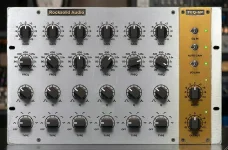
Rocksolid Audio lists oversampling among the features of its circuit-modeled TEQ-6P processing, alongside modeled valves and transformers. Oversampling makes more sense in that context because the processor is doing more than reshaping a frequency response.
The useful distinction is not whether EQ plugins need oversampling as a category. Some do, some do not, and a single plugin can contain sections with very different needs. What matters is where new frequencies are being created and whether those products can fold back into the audible band.
Drive a modeled valve or transformer harder, and the processor may generate harmonics above the original signal. Once those products rise past the Nyquist limit of the current sample rate, they cannot be represented normally and can reappear lower in the spectrum as aliases.
Oversampling gives the nonlinear section more frequency room to work. The plugin raises its internal sample rate, performs the nonlinear processing, filters the result, and returns to the session rate. The higher internal Nyquist limit means more generated harmonics can exist before they reach the point where folding becomes a problem.
An analog-style EQ can therefore benefit even when its actual EQ filters are well behaved. The filter may be linear while the modeled input, valve, transformer, output, or feedback path is not. Calling the whole plugin an EQ hides the part of the signal path that creates the oversampling problem.
Drive level matters just as much as the label on the plugin. A gently used nonlinear EQ may generate little troublesome high-order content, while the same processor pushed hard can produce much more. Bright source material can also put generated harmonics closer to Nyquist from the start.
Internal oversampling and a high project sample rate are not identical workflows, though. Raising the session rate affects the entire project, including instruments, routing, storage, and CPU demand. Plugin oversampling can target the expensive processing only where a developer or mixer thinks it matters.
More is not automatically safer. Higher factors increase the amount of internal work, and the conversion filters themselves have design tradeoffs involving latency, phase behavior, transition width, and computational cost. Two plugins set to 4x can therefore behave differently because the multiplier says nothing about the quality or type of filtering around the nonlinear stage.
Published research on oversampling filters for nonlinear waveshaping compared different interpolation and decimation filters at the same eight-times oversampling factor. The results showed meaningful differences in alias suppression between filter choices. The number printed beside an oversampling switch is only one part of the system.
Listening at matched loudness is more useful than assuming 8x must beat 2x. Try the settings with the actual source and drive level you intend to use, because aliasing risk rises with nonlinear severity and spectral content. A clean vocal EQ move and a heavily driven drum-bus treatment can place completely different demands on the same processor.
A sine sweep can expose obvious foldback, but it is a stress test rather than normal music. Bright percussion, distorted guitars, dense synths, or aggressive boosts into a nonlinear stage often reveal practical differences more quickly. If higher oversampling removes a brittle or inharmonic edge without harming the feel, the extra CPU is doing useful work.
Leaving every plugin at its maximum setting is a poor substitute for knowing where the nonlinear stages are. Use oversampling where the processor is creating enough new high-frequency content for aliasing to matter, then judge the result in context. A nonlinear EQ earns the setting through its behavior, not through the word EQ on the interface.
Rocksolid Audio lists oversampling among the features of its circuit-modeled TEQ-6P processing, alongside modeled valves and transformers. Oversampling makes more sense in that context because the processor is doing more than reshaping a frequency response.
The useful distinction is not whether EQ plugins need oversampling as a category. Some do, some do not, and a single plugin can contain sections with very different needs. What matters is where new frequencies are being created and whether those products can fold back into the audible band.
Nonlinear stages create the reason to oversample
A linear filter does not invent harmonics from a sine wave. Feed it 1 kHz, and it can change the level or phase of that tone, but it does not suddenly create a stack at 2, 3, or 4 kHz. A nonlinear stage can.Drive a modeled valve or transformer harder, and the processor may generate harmonics above the original signal. Once those products rise past the Nyquist limit of the current sample rate, they cannot be represented normally and can reappear lower in the spectrum as aliases.
Oversampling gives the nonlinear section more frequency room to work. The plugin raises its internal sample rate, performs the nonlinear processing, filters the result, and returns to the session rate. The higher internal Nyquist limit means more generated harmonics can exist before they reach the point where folding becomes a problem.
An analog-style EQ can therefore benefit even when its actual EQ filters are well behaved. The filter may be linear while the modeled input, valve, transformer, output, or feedback path is not. Calling the whole plugin an EQ hides the part of the signal path that creates the oversampling problem.
Drive level matters just as much as the label on the plugin. A gently used nonlinear EQ may generate little troublesome high-order content, while the same processor pushed hard can produce much more. Bright source material can also put generated harmonics closer to Nyquist from the start.
Project sample rate changes the size of the problem
A 48 kHz session has a Nyquist frequency of 24 kHz. A 96 kHz session moves it to 48 kHz, giving nonlinear processing substantially more room before newly created harmonics cross the limit. The plugin may therefore need less internal oversampling at the higher project rate.Internal oversampling and a high project sample rate are not identical workflows, though. Raising the session rate affects the entire project, including instruments, routing, storage, and CPU demand. Plugin oversampling can target the expensive processing only where a developer or mixer thinks it matters.
More is not automatically safer. Higher factors increase the amount of internal work, and the conversion filters themselves have design tradeoffs involving latency, phase behavior, transition width, and computational cost. Two plugins set to 4x can therefore behave differently because the multiplier says nothing about the quality or type of filtering around the nonlinear stage.
Published research on oversampling filters for nonlinear waveshaping compared different interpolation and decimation filters at the same eight-times oversampling factor. The results showed meaningful differences in alias suppression between filter choices. The number printed beside an oversampling switch is only one part of the system.
The highest setting is not a universal quality mode
Turning oversampling to its maximum can increase CPU load and may add latency, depending on the implementation. Some filter choices can also change phase relationships or peak levels, which matters when processed and dry paths are recombined or when the plugin sits inside a mastering chain.Listening at matched loudness is more useful than assuming 8x must beat 2x. Try the settings with the actual source and drive level you intend to use, because aliasing risk rises with nonlinear severity and spectral content. A clean vocal EQ move and a heavily driven drum-bus treatment can place completely different demands on the same processor.
A sine sweep can expose obvious foldback, but it is a stress test rather than normal music. Bright percussion, distorted guitars, dense synths, or aggressive boosts into a nonlinear stage often reveal practical differences more quickly. If higher oversampling removes a brittle or inharmonic edge without harming the feel, the extra CPU is doing useful work.
Leaving every plugin at its maximum setting is a poor substitute for knowing where the nonlinear stages are. Use oversampling where the processor is creating enough new high-frequency content for aliasing to matter, then judge the result in context. A nonlinear EQ earns the setting through its behavior, not through the word EQ on the interface.