Serial Killers in Zimbabwe - Notorious cases from the past

Zimbabwe has witnessed several unsettling murder cases involving serial killers whose actions stunned the public. Although these incidents are not common, each example left a lasting mark on local communities. Authorities tracked the culprits through intense investigations that often took months or even years. Each figure described here faced legal consequences, with some receiving the harshest penalties under Zimbabwean law. The stories range from an axe-wielding criminal in the early 1980s to a medical professional who disturbingly misused his role. The most recent incidents involve killers who hunted victims on city streets, leaving the nation shocked and demanding answers. This overview delves into the grim details of each case in an accessible style. It avoids complicated terms and maintains a vivid, active voice.

Sampson Kanderayi, The Axe Killer​

Sampson Kanderayi gained infamy around the early 1980s through a shocking string of murders. He often targeted unsuspecting individuals in isolated spots, wielding an axe as his weapon of choice. Reports suggest that he ended dozens of lives in an incredibly short span, leaving citizens fearing late-night walks. He once escaped custody and returned to commit more violent acts. Authorities later tracked him through suspicious patterns linked to his typical method. Kanderayi insisted that his actions had a spiritual element, though investigators found no clear reasoning beyond robbery and a willingness to kill. When law enforcement cornered him, he confessed to many killings and provided details on his methods. He never completed a formal trial since he took his own life in custody. Many people remember his case as one of the most terrifying chapters in the nation's legal history.

Edgar Masendeke and Stephen Chidumo: A Deadly Duo​

In the mid-1990s, Edgar Masendeke and Stephen Chidumo teamed up to unleash a series of robberies and killings across several provinces. Their ability to slip past the authorities caused widespread alarm, and newspapers of that era called them among the most brutal criminals in the country. They stole from homes and businesses, often opening fire on anyone who tried to resist. Their spree escalated further when they escaped from a high-security prison and remained at large for an extended period. Police forces set up roadblocks and followed scattered reports of sightings in rural areas. After long efforts, they succeeded in capturing the pair. The courts heard tragic testimony from survivors who described the torment inflicted through shootings, stabbings, and beatings. Both men received the ultimate sentence under Zimbabwean law and were eventually hanged. This outcome provided a measure of relief for citizens who had lived through their terrifying reign of violence.

Richard McGown, The Doctor Turned Killer​

Not all of Zimbabwe's serial murderers operated in the streets. Richard McGown, sometimes referred to through a chilling nickname that linked him with death, practiced as an anaesthetist in Harare. Authorities discovered that some patients never woke up, raising suspicions about improper dosages of strong painkillers. Investigations uncovered patterns in the timing and nature of these deaths. Observers grew alarmed that this medical professional might have tested dangerous drug levels on unsuspecting individuals. Court proceedings ended with a finding that he had contributed to the deaths of at least two young patients. The judge ruled that his negligence or misconduct led to a form of homicide. Many expected a heavier sentence, yet he served only a short term in prison. Outrage followed his release, especially among the grieving families who felt that justice had not been served. His case remains one of the most controversial in Zimbabwe's legal archives. It highlights a rare example of a healthcare worker who crossed a line that cost innocent lives.

Bright Zhantali, A Predator of Recent Times​

Bright Zhantali's crimes came to light in the early 2020s when law enforcement tied a series of killings to one suspect. He preyed on women who traveled alone, often targeting individuals in nightlife areas or near highways. Many victims were robbed, assaulted, and strangled or beaten. Investigators tracked him through repeated patterns and some physical evidence left at the scenes. In one tragic twist, he had previously been granted bail after an earlier murder accusation. Local papers criticized the justice system for allowing him to go free since that decision may have allowed him to continue hunting for victims. After he was apprehended, he led officers to spots where more bodies were found, leading some to suspect that his total victim count reached double digits. The courts ordered psychiatric evaluations when he behaved in odd ways during hearings, which delayed the trial. The revelations of his crimes generated widespread anger and demands for tighter controls on bail for suspects in violent cases.

Thandolwenkosi Ndlovu The Cannibal of Harare​

Thandolwenkosi Ndlovu is an example of the extreme brutality that surfaced in 2023. He targeted homeless people and reportedly attacked them in the dead of night. The details are gruesome. Reports indicate that he used stones or bricks to crush the heads of his victims, then performed acts of dismemberment that suggested cannibalistic intent. This pattern emerged over a short stretch, causing growing fear among vulnerable communities who slept outdoors. Rumors spread about a menacing figure lurking near abandoned buildings. Detectives saw similarities between these attacks and earlier ones in a different city, raising the possibility that he had been active for longer than originally believed. His capture came when a would-be victim managed to survive an assault and contacted authorities. That individual identified him, which led to an arrest. In custody, he spoke calmly about his actions, according to investigators. Legal proceedings began soon afterward. Some experts believe that this suspect might have mental health issues, though families of the deceased demanded firm punishment. His case drew attention to the dangers faced daily on city streets.

Continuing Impact of These Cases​

The public often reflects on these cases and wonders how such individuals emerged in otherwise peaceful communities. Some attribute the rise of violent crime to economic or social pressures. Others note that serial killers can appear anywhere and that no society is immune from random acts of brutality. Each example also influenced policy changes, such as stricter rules around bail for dangerous suspects. Police units developed new investigative methods, including improved coordination across different regions. Community watch groups gained momentum, and citizens became more vigilant about reporting suspicious activities. Certain charitable organizations also stepped in to support survivors and victims' relatives, offering counseling and legal guidance when needed.

Courtroom Responses and Lessons Learned​

Lawmakers and judges took different approaches in handling these offenders. Some received death sentences, reflecting the severity of their crimes. Others were handed lengthy prison terms. A few, such as the doctor who misused anaesthesia, received penalties that many found too lenient. Observers often debate whether harsher sentences truly deter crime. Public discussion around these trials can lead to shifts in how homicide cases are prosecuted. There is also the question of mental health since some killers showed signs of severe disorders. Zimbabwean society appears determined to ensure that no oversight allows predators to continue harming people. Law enforcement has strengthened forensic science approaches to match international standards, including DNA analysis and deeper profiling of suspects who exhibit certain patterns. Observers believe that this path will help identify criminals faster and prevent them from claiming more lives.

Reflections on National Awareness​

These stories, though horrific, serve as warnings that anyone can be targeted. They also highlight the resilience of communities that unite against fear. Investigators worked long hours to solve these mysteries, sometimes facing limited resources. Family members of victims demanded justice, and their efforts often pushed officials to go further in gathering evidence. Many journalists followed the court cases, shining a light on courtroom proceedings that might otherwise remain hidden. Campaigners also used these examples to call for more support for vulnerable groups. It became clear that certain killers targeted individuals on the margins of society, such as those in poverty or those lacking strong family networks. Attention turned toward social services, mental health care, and community education to help deter violent behavior and protect potential victims.

Final Thoughts​

Zimbabwe's experience with convicted serial killers underlines the importance of swift action and thorough investigations. Over several decades, each case brought its lessons for law enforcement, lawmakers, and the public. In each instance, the killers were eventually caught through a mix of evidence collection and collaboration among various agencies. The legal system responded with penalties that aimed to reflect the severity of these crimes. Some cases sparked debate about sentencing, particularly when a medical professional abused trust in a hospital setting. Others presented unusual features, including cannibalistic acts or multiple escapes from custody. Citizens continue to show resilience in facing these nightmares. Families of victims also stand strong, ensuring that loved ones are not forgotten. Many people hope that heightened awareness and updated investigative techniques will reduce the likelihood of further atrocities. Those who lost relatives or friends often speak of a desire for vigilance in daily life. With each passing case, Zimbabwe's authorities refine their ability to handle violent criminals, and communities gain a stronger sense of unity. It appears that lessons learned from these tragic chapters will remain part of the national consciousness for years to come.
 

Attachments

  • Serial Killers in Zimbabwe - Notorious Cases from Past.webp
    Serial Killers in Zimbabwe - Notorious Cases from Past.webp
    272.8 KB · Views: 357

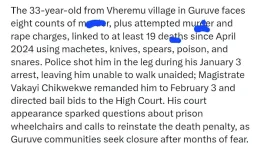
Guruve killer was finally caught, leg shot off, hiding in garden​

The manhunt for that absolute monster in Guruve is officially over. Authorities finally snagged suspected serial killer Anymore Zvitsva after a joint team involving the Zimbabwe Republic Police and Zimbabwe National Army put a bullet in his leg while he crouched inside a garden. Paul Nyathi confirmed officers caught the fugitive who allegedly slaughtered twelve people across the region. This capture ends a terrified three-week period where locals feared the suspect who targeted women and children while hiding out in the mountains.

Zvitsva currently receives treatment at a local hospital for the gunshot wound sustained during the raid. Accusations against the thirty-two-year-old from Bangira Village involve wiping out five family members at Ona Farm and bludgeoning an elderly woman alongside an infant at Farm 88 in Nyakapupu. Reports suggest the victims suffered severe head injuries.
 

Attachments

  • Guruve killer was finally caught, leg shot off, hiding in garden​.webp
    Guruve killer was finally caught, leg shot off, hiding in garden​.webp
    9.9 KB · Views: 41
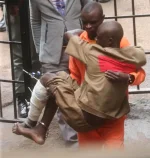
Zimbabwe serial killer Anymore Zvitsva was carried into court in Harare.
 

Attachments

  • Zimbabwe serial killer Anymore Zvitsva was carried into court 1.webp
    Zimbabwe serial killer Anymore Zvitsva was carried into court 1.webp
    40.1 KB · Views: 41
  • Zimbabwe serial killer Anymore Zvitsva was carried into court 2.webp
    Zimbabwe serial killer Anymore Zvitsva was carried into court 2.webp
    43 KB · Views: 35
  • Zimbabwe serial killer Anymore Zvitsva was carried into court 3.webp
    Zimbabwe serial killer Anymore Zvitsva was carried into court 3.webp
    13 KB · Views: 36
  • Zimbabwe serial killer Anymore Zvitsva was carried into court 4.webp
    Zimbabwe serial killer Anymore Zvitsva was carried into court 4.webp
    37.8 KB · Views: 35

Man receives double life sentence for burning children alive​

Abel Mativenga burned kids alive, the court nuked him with double life, and everyone is calling it pure evil with zero excuses.

Verdict and punishment
  • Abel Mativenga received two life terms.
  • The ruling came from the High Court.
  • Judges cited cruelty and planning.
  • Mercy was completely off the table.
Victims and method
  • Everjoy Mangena and Natasha Kanyama were killed.
  • The ages were thirteen and five.
  • They were trapped inside a hut.
  • Fire was deliberately set.
Motive and buildup
  • Rage followed witchcraft claims against his parents.
  • Warnings to cool off were ignored.
  • A lighter became the weapon.
  • The plan unfolded step by step.
What prosecutors laid out
  • The National Prosecuting Authority of Zimbabwe detailed the sequence.
  • The door was wired shut.
  • He watched rescue attempts fail.
  • The structure collapsed in flames.
Forensic aftermath
  • Both bodies were recovered later.
  • Burns covered the entire body.
  • Death was instant.
  • Escape was made impossible.
Timing and location
  • The attack happened on March 19, 2025.
  • The setting was a rural hut.
  • The offender lived nearby.
  • Neighbors arrived after ignition.
Message to communities
  • Prosecutors want early intervention.
  • Warning signs should be reported.
  • Conflicts must stay nonviolent.
  • Children must be protected at all costs.
 

Attachments

  • Man receives double life sentence for burning children alive.webp
    Man receives double life sentence for burning children alive.webp
    174 KB · Views: 41

ZRP arrest Obedience Makonye for the Zaka student murders​

Masvingo just lived through a brutal stretch where kids died walking home or trying to get back, and police are sounding alarms.

Double murder in Zaka
  • Obedience Makonye, age 29, was arrested by the Zimbabwe Republic Police.
  • Allegedly lured Elizabeth Munetsi, 14, and Shepherd Makonye, 9.
  • Led them toward Gondora Mountain while walking home from school.
  • Police say both children were killed to hide sexual abuse.
Arrest and evidence details
  • Confessed after being taken into custody.
  • Bodies were later recovered by authorities.
  • A kitchen knife was found and linked as the weapon.
  • The case shook the wider Zaka community.
Chiredzi child killing
  • Steadfast Makondo, age four, vanished after leaving school.
  • Body found in Newtown, Chiredzi, under a Marula tree.
  • Police reported visible bruising.
  • Murder investigation remains active.
Boat tragedy at Tugwi-Mukosi
  • A vessel carrying ten people capsized on the dam.
  • Leona Zendekanyi, 26, drowned.
  • Saint Munyaradzi, age three, also died.
  • Police say the boat struck a hard object.
Police warning to families
  • The Zimbabwe Republic Police issued an urgent safety alert.
  • Parents urged to escort young children to school.
  • Extra caution is stressed for ECD and primary learners.
  • Water travel safety rules are reinforced immediately.
 

Attachments

  • Police arrest Obedience Makonye for Zaka student murders.webp
    Police arrest Obedience Makonye for Zaka student murders.webp
    20.5 KB · Views: 38

Serial killers versus murderers​

Serial killers and murderers both take lives, yet they differ in ways that shape how society views crime. People commit murder for many reasons, but serial killers stand out due to their repeated acts over time. Law enforcement studies these differences to grasp what drives such violence. This exploration covers definitions, psychology, methods, legal aspects, examples, media views, and ways to spot or stop them.

What defines a serial killer​

Murder happens when someone unlawfully kills another person. A murderer might act once, driven by anger or greed. Serial killers commit multiple murders, usually three or more, spread out over weeks, months, or years. They pause between killings, a time experts call a cooling-off period. This break lets them return to normal life before striking again.

Mass murderers kill several people at once in one place, like a shooting rampage. Spree killers murder in different spots over a short span, with no real pause. Serial killers plan separate events, often picking similar victims based on looks or background. The FBI notes serial murder as two or more killings by the same person in distinct incidents. This sets serial killers apart from regular murderers, who often kill just once without a pattern.

Psychological traits that set them apart​

Serial killers often show deep mental issues. Many lack empathy and feel no guilt after their acts. Psychopathy marks them, with traits like charm on the surface but coldness inside. Childhood harm plays a big role. Abuse or neglect warps their emotions, making it hard to connect with others.

Regular murderers might snap from stress, like a fight or betrayal. Their acts stem from immediate problems, not a lifelong urge. Serial killers seek thrill or control. Some hear voices or believe they must eliminate certain people. Others kill for sexual reasons or power. Men hunt strangers, while women target those they know, often for money. Both groups might have brain differences, but serial killers blend into society better between crimes. Regular murderers rarely hide their deeds as well, since their killings lack the repeated practice.

Patterns in how they operate​

Serial killers follow routines. They stalk victims, plan attacks, and dispose of bodies to avoid capture. They might use the same weapon or method each time, like strangling or poisoning. Cooling-off periods help them evade notice. They learn from past mistakes, getting better at hiding evidence. Regular murderers act on impulse.

A spouse kills in rage, or a robber shoots during a heist. No planning spans months. Serial killers select victims who fit a type, such as young women or children. They cover tracks by moving bodies or using remote spots. Regular murders happen in homes or on the streets, with witnesses nearby. Serial acts spread across areas, complicating police work. Some serial killers taunt authorities with clues, seeking attention. Regular murderers flee or confess quickly.

Legal challenges in handling cases​

Laws treat all murders seriously, but serial cases demand more resources. Prosecutors charge multiple counts of murder, not a special "serial" label. Evidence links crimes through patterns, like DNA or methods. Regular murders involve one trial, easier to prove with direct proof. Serial trials last longer, with victims from different places. Juries hear graphic details over time. Penalties include life sentences or death, based on state rules.

Serial killers face consecutive terms, ensuring they never leave prison. Investigations differ. Police form task forces for serial cases, using profiles to narrow suspects. Regular murders rely on witnesses or motives. Linking serial crimes takes years, as bodies turn up slowly. Courts sometimes declare serial killers insane, but most understand right from wrong. Regular murderers might plead temporary insanity from emotion.

Notable cases that highlight contrasts​

Ted Bundy charmed victims before killing over 30 women across the United States in the 1970s. He planned escapes and denied crimes until the end. Jeffrey Dahmer lured men to his home, killing 17 from 1978 to 1991, often keeping parts. These men repeated acts with precision. One-time murderers include Lizzie Borden, accused of axing her parents in 1892 over family tensions. She acted once, in her home.

O.J. Simpson faced charges for two killings in 1994, tied to personal disputes. No pattern followed. John Wilkes Booth shot President Lincoln in 1865 for political reasons, then fled without more. Serial cases like Jack the Ripper's five murders in 1888 remain unsolved due to spacing. One-time acts like the Lindbergh baby kidnapping in 1932 ended with one death, solved faster. These examples show serial repetition versus single outbursts.

How the media shapes public views​

The media turns serial killers into stars. Shows and books detail their lives, making them seem intriguing. Bundy and Dahmer get films that focus on their looks or smarts. Regular murderers fade from headlines unless tied to fame. A local stabbing gets brief coverage. Serial stories build suspense with each victim. Podcasts explore motives, drawing fans who debate theories.

This glamorizes serial acts, sometimes sparking copycats. Regular murders appear in the news as warnings, not entertainment. Social platforms share serial memes or edits, humanizing killers. Victims' families suffer from the spotlight. The media rarely probes regular murders deeply, unless sensational. Serial coverage sells, feeding curiosity about evil.

Strategies for spotting and stopping them​

Detection starts with linking crimes. Police use databases for patterns in wounds or sites. Profiles predict age, job, or habits based on scenes. Regular murders are solved more quickly with alibis or cameras. Prevention targets risks. Schools spot abuse early, offering help to troubled kids. Therapy addresses trauma before it festers. Communities watch for odd behavior, like animal harm. Law enforcement trains on serial signs, sharing info across borders.

DNA tech catches serial killers faster now. Regular prevention focuses on gun control or conflict resolution. Public tips aid serial hunts, as killers slip up over time. Early arrests stop escalation. Research shows fewer serial cases today due to better tools. Both types need vigilance, but serial demand requires ongoing effort.

Serial killers puzzle experts with their ability to kill repeatedly without remorse. Murderers, in general, act from clear triggers, easier to understand. Society learns from both to build safer systems. Patterns reveal human darkness, urging better mental health support. Differences guide how police and courts respond, saving lives through knowledge.

 

Similar threads

Trending content

Sponsored

Top