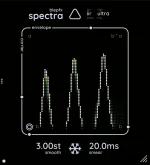
blepfx Spectra includes envelope freeze alongside Smooth and Smear, giving its spectral-envelope processing a way to stop following a continuously changing source. The result is not simply a looped piece of audio.
Spectra already separates broad spectral shape from finer harmonic detail before recombining the main and sidechain signals. Freeze becomes more interesting in that context because a held envelope can stay fixed while other parts of the sound continue to change.
A captured vowel can keep its resonant shape while the carrier moves underneath it, or a drum-derived contour can remain parked over a sustained source. Spectra’s envelope freeze control therefore works less like stopping playback and more like holding one layer of timbral information still.
With Spectra, the useful target is the envelope side of its processing. The envelope is the broad contour that describes resonant emphasis across the spectrum, while the carrier contributes the finer harmonic material that gets shaped by that contour. Hold the contour, and the carrier can still supply motion.
This separation changes what you should listen for. A frozen vowel shape over a shifting synth does not need to sound like a sustained recording of the singer, because the harmonic material can come from somewhere else. You are preserving the spectral emphasis that made the captured instant distinctive.
A single-frame spectral freezing method holds one analyzed spectral frame for an extended period. Spectra’s envelope-focused approach gives you a narrower target, which is useful when you want the contour to persist without turning the entire sound into a static drone.
Sustained material makes this easy to learn. Hold a vowel, pad, reed, or resonant synth note, then capture several moments while the source remains reasonably stable. Small timing changes can reveal how much the envelope itself is moving even when the pitch sounds steady.
Transient material is less forgiving but often more interesting. Capture too close to a noisy attack, and the envelope may emphasize broad high-frequency energy rather than the body you expected. Move a little later and the same hit can yield a darker, more resonant contour.
Smooth matters here because it controls how much fine spectral detail belongs to the envelope. A heavily detailed envelope can make a frozen snapshot feel more specific and artificial, while stronger smoothing reduces narrow features and leaves a broader tonal shape. Neither setting is inherently better.
Dense carriers usually give the held contour more material to shape. Noise, rich synth waves, stacked harmonics, or busy sidechain material contain energy across enough of the spectrum for the frozen envelope to carve into something recognizable. Sparse carriers can leave gaps where the captured contour has little energy available to emphasize.
Carrier movement also prevents the result from feeling pinned to one instant. Change chords beneath a frozen vocal envelope, and the resonance stays familiar while the harmonic foundation shifts. Use a rhythmic carrier and the same frozen shape can pulse with new articulation instead of stretching into a continuous wash.
Smear offers another route because it controls separation through time. More smearing can soften rapid envelope changes before or around the freeze, while restrained settings keep the captured contour more tightly tied to a specific instant. It is worth choosing the freeze point first, then adding temporal blur deliberately.
The strongest captures usually contain a clear spectral identity without too much accidental noise. A stable vowel, resonant percussion tail, brass sustain, or filtered synth tone gives the freeze something definite to preserve. Once the envelope is held, movement can come from the carrier instead of from the captured source itself.
Spectra already separates broad spectral shape from finer harmonic detail before recombining the main and sidechain signals. Freeze becomes more interesting in that context because a held envelope can stay fixed while other parts of the sound continue to change.
A captured vowel can keep its resonant shape while the carrier moves underneath it, or a drum-derived contour can remain parked over a sustained source. Spectra’s envelope freeze control therefore works less like stopping playback and more like holding one layer of timbral information still.
Envelope freeze holds shape rather than ordinary audio
Spectral processing works with short analysis frames that describe what energy exists across frequency at a given moment. Freezing spectral information means keeping one of those analyzed states instead of continually replacing it with new input, which is why the effect can sustain a recognizable timbre without replaying an obvious waveform loop.With Spectra, the useful target is the envelope side of its processing. The envelope is the broad contour that describes resonant emphasis across the spectrum, while the carrier contributes the finer harmonic material that gets shaped by that contour. Hold the contour, and the carrier can still supply motion.
This separation changes what you should listen for. A frozen vowel shape over a shifting synth does not need to sound like a sustained recording of the singer, because the harmonic material can come from somewhere else. You are preserving the spectral emphasis that made the captured instant distinctive.
A single-frame spectral freezing method holds one analyzed spectral frame for an extended period. Spectra’s envelope-focused approach gives you a narrower target, which is useful when you want the contour to persist without turning the entire sound into a static drone.
Capture timing decides whether the freeze feels useful
The moment you freeze matters more than the length of the source. A vowel changes continuously during speech, a snare moves from a noisy attack into a darker tail, and a guitar note loses upper harmonics as it decays. Freeze at different points, and you are effectively choosing different spectral shapes.Sustained material makes this easy to learn. Hold a vowel, pad, reed, or resonant synth note, then capture several moments while the source remains reasonably stable. Small timing changes can reveal how much the envelope itself is moving even when the pitch sounds steady.
Transient material is less forgiving but often more interesting. Capture too close to a noisy attack, and the envelope may emphasize broad high-frequency energy rather than the body you expected. Move a little later and the same hit can yield a darker, more resonant contour.
Smooth matters here because it controls how much fine spectral detail belongs to the envelope. A heavily detailed envelope can make a frozen snapshot feel more specific and artificial, while stronger smoothing reduces narrow features and leaves a broader tonal shape. Neither setting is inherently better.
A moving carrier keeps a frozen envelope alive
A fixed envelope does not require a fixed result. Feed changing harmonic material underneath it, and the output can keep moving in pitch, rhythm, density, or articulation while retaining the same broad spectral identity. This is where envelope freeze becomes more useful than a simple sustained pad effect.Dense carriers usually give the held contour more material to shape. Noise, rich synth waves, stacked harmonics, or busy sidechain material contain energy across enough of the spectrum for the frozen envelope to carve into something recognizable. Sparse carriers can leave gaps where the captured contour has little energy available to emphasize.
Carrier movement also prevents the result from feeling pinned to one instant. Change chords beneath a frozen vocal envelope, and the resonance stays familiar while the harmonic foundation shifts. Use a rhythmic carrier and the same frozen shape can pulse with new articulation instead of stretching into a continuous wash.
Smear offers another route because it controls separation through time. More smearing can soften rapid envelope changes before or around the freeze, while restrained settings keep the captured contour more tightly tied to a specific instant. It is worth choosing the freeze point first, then adding temporal blur deliberately.
The strongest captures usually contain a clear spectral identity without too much accidental noise. A stable vowel, resonant percussion tail, brass sustain, or filtered synth tone gives the freeze something definite to preserve. Once the envelope is held, movement can come from the carrier instead of from the captured source itself.