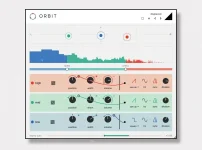
Orbit lets each non-envelope modulator run at a free rate in hertz or lock its cycle length to a DAW tempo division. Both settings can produce the same left-right motion, but they solve different timing problems once the arrangement starts moving.
Tempo sync is useful when the pan cycle needs a musical relationship with the beat. Free-running mode is useful when you want motion measured in seconds rather than notes, so the pan keeps its own pace instead of following tempo changes.
The distinction matters more on SoundGhost Orbit's independent band modulators because Low, Mid, and High can all move at different rates. A single sound can contain one rhythmically locked band and another that drifts across the grid.
This works well for percussion, chopped loops, rhythmic synths, and anything whose stereo movement should reinforce the groove. A square wave at a synced division can create abrupt left-right changes, while a sine at the same division traces a smoother path over the same musical duration.
Multiple synced bands can create a larger repeating pattern. Put one band on a one-bar cycle, another on a half-bar cycle, and another on a quarter-bar cycle, and their relative motions keep returning to the same relationship during continuous playback. Change one rate to another musical division and the composite stereo pattern changes without touching the source notes.
Sync does not automatically mean retrigger. Rate synchronization tells a modulator how long its cycle should last relative to tempo, while phase reset determines where the waveform begins after playback or a trigger. Orbit provides free-rate and tempo-division controls, but no separate user-facing phase-reset parameter, so exact restart behavior is worth auditioning instead of assuming.
This suits pads, drones, sustained guitars, ambience, and background layers where strict bar-by-bar repetition can sound too deliberate. The pan keeps slipping against kicks, snares, chord changes, and section boundaries because its cycle was never defined by those events.
Human hearing can distinguish changes in low modulation rates, which helps explain why small rate adjustments can noticeably change slow movement, as documented in rate-discrimination measurements with normal-hearing listeners. A tiny rate change on a long sweep can alter where the sound happens to sit several bars later even when modulation depth stays untouched.
Free mode also behaves differently when a song contains tempo automation. A hertz value keeps the same seconds-per-cycle timing while the music speeds up or slows down, so its relationship with the bar drifts. Synced modulation follows the new tempo instead, which fits better when stereo motion is part of the rhythm.
Free-running motion can accidentally land near a musical division too. At one tempo, a particular hertz value may line up closely with the bar for a while, then fall out of step after a tempo change or after enough cycles expose the mismatch. Hearing a temporary lock does not make the modulator tempo synced.
Use sync when the position change needs to repeat with the arrangement. Repeated percussion, alternating synth stabs, call-and-response parts, and transitions often benefit because you can choose a division with a clear relationship to the notes already on the grid.
Use free rate when repetition itself is the problem. A static pad can feel less pinned to the loop when its upper band takes its own slow path, while the low band stays static or follows a separate synced movement. Small mismatches between rates create longer evolving combinations before the same spatial relationship comes around again.
Depth still decides whether any of this sounds tasteful. A perfectly chosen rate can become distracting when every cycle travels from one extreme to the other, especially on vocals, bass weight, or sharp transients. Set the timing first, then reduce the amount until the movement supports the arrangement instead of becoming another part demanding attention.
Tempo sync gives you predictable musical duration, while free running gives you independent clock-time motion. Picking between them comes down to whether the stereo movement should obey the song's grid or keep moving when the grid changes underneath it.
Tempo sync is useful when the pan cycle needs a musical relationship with the beat. Free-running mode is useful when you want motion measured in seconds rather than notes, so the pan keeps its own pace instead of following tempo changes.
The distinction matters more on SoundGhost Orbit's independent band modulators because Low, Mid, and High can all move at different rates. A single sound can contain one rhythmically locked band and another that drifts across the grid.
Tempo sync controls cycle length in musical time
Switch Orbit to its clock mode, and the rate control becomes a note division instead of a hertz value. A quarter-note cycle gets shorter when the DAW tempo rises and longer when it falls, while its musical relationship with the beat stays intact.This works well for percussion, chopped loops, rhythmic synths, and anything whose stereo movement should reinforce the groove. A square wave at a synced division can create abrupt left-right changes, while a sine at the same division traces a smoother path over the same musical duration.
Multiple synced bands can create a larger repeating pattern. Put one band on a one-bar cycle, another on a half-bar cycle, and another on a quarter-bar cycle, and their relative motions keep returning to the same relationship during continuous playback. Change one rate to another musical division and the composite stereo pattern changes without touching the source notes.
Sync does not automatically mean retrigger. Rate synchronization tells a modulator how long its cycle should last relative to tempo, while phase reset determines where the waveform begins after playback or a trigger. Orbit provides free-rate and tempo-division controls, but no separate user-facing phase-reset parameter, so exact restart behavior is worth auditioning instead of assuming.
Free-running panning can avoid obvious repetition
Free mode measures modulation rate in hertz, so the cycle belongs to clock time rather than the project grid. If a pan runs at 0.37 Hz, it completes 0.37 cycles per second whether the track is at 90 BPM or 140 BPM.This suits pads, drones, sustained guitars, ambience, and background layers where strict bar-by-bar repetition can sound too deliberate. The pan keeps slipping against kicks, snares, chord changes, and section boundaries because its cycle was never defined by those events.
Human hearing can distinguish changes in low modulation rates, which helps explain why small rate adjustments can noticeably change slow movement, as documented in rate-discrimination measurements with normal-hearing listeners. A tiny rate change on a long sweep can alter where the sound happens to sit several bars later even when modulation depth stays untouched.
Free mode also behaves differently when a song contains tempo automation. A hertz value keeps the same seconds-per-cycle timing while the music speeds up or slows down, so its relationship with the bar drifts. Synced modulation follows the new tempo instead, which fits better when stereo motion is part of the rhythm.
Rate choice matters more than the mode label
A synced LFO is not automatically rhythmic in a useful way. Put a slow sine on a four-bar division and the motion may read as a gentle drift, while a fast square wave can turn panning into an obvious pattern that competes with hats, percussion, or vocal phrasing.Free-running motion can accidentally land near a musical division too. At one tempo, a particular hertz value may line up closely with the bar for a while, then fall out of step after a tempo change or after enough cycles expose the mismatch. Hearing a temporary lock does not make the modulator tempo synced.
Use sync when the position change needs to repeat with the arrangement. Repeated percussion, alternating synth stabs, call-and-response parts, and transitions often benefit because you can choose a division with a clear relationship to the notes already on the grid.
Use free rate when repetition itself is the problem. A static pad can feel less pinned to the loop when its upper band takes its own slow path, while the low band stays static or follows a separate synced movement. Small mismatches between rates create longer evolving combinations before the same spatial relationship comes around again.
Depth still decides whether any of this sounds tasteful. A perfectly chosen rate can become distracting when every cycle travels from one extreme to the other, especially on vocals, bass weight, or sharp transients. Set the timing first, then reduce the amount until the movement supports the arrangement instead of becoming another part demanding attention.
Tempo sync gives you predictable musical duration, while free running gives you independent clock-time motion. Picking between them comes down to whether the stereo movement should obey the song's grid or keep moving when the grid changes underneath it.