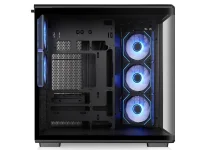
The View 590 TG ARGB ships with five 120 mm fans and supports up to eleven 120 mm fans in total. Three reverse-blade ARGB fans sit on the right side, while two conventional 120 mm ARGB fans occupy the rear positions.
The stock layout matters more than the maximum fan count. Six 120 mm positions remain open at the top and bottom, so you can expand airflow without immediately disturbing the five fans Thermaltake already fitted.
A 360 mm AIO changes the picture because its radiator has only two full-size slots. The top and side both accept 360 mm radiators, but the View 590 TG ARGB cooling layout gives each position a different effect on the rest of the build.
The rear pair can remain in place as well. If you run the top radiator as exhaust, the case keeps a simple path with side air entering near the main components and warm air leaving through the roof and rear.
CPU temperature is not the only variable in that choice. An exhaust-mounted roof radiator receives air that has already picked up some heat inside the case, while a roof intake gives the radiator cooler room air but sends its warmed air into the chassis.
Neither arrangement guarantees a particular temperature without testing the finished system. The practical advantage is flexibility because the top position does not trigger Thermaltake's reduced 350 mm graphics-card limit associated with a side radiator.
A top 360 mm AIO therefore suits a build where GPU space matters more than squeezing every possible degree from the CPU loop. It also avoids dismantling the case's most distinctive factory airflow feature, the angled trio of reverse fans beside the motherboard.
The fan-fed radiator cooling arrangement behind a liquid loop depends on moving air through a heat exchanger, so radiator placement always affects where that warmed air goes. In a dual-chamber showcase case, the cleanest-looking position is not automatically the least disruptive one.
Side mounting can give the CPU loop direct access to outside air when configured as intake. The trade-off is straightforward because air leaving the radiator enters the main chamber after collecting CPU heat, placing more of that heat near the GPU and motherboard.
The bigger constraint is physical rather than thermal. Thermaltake rates graphics-card clearance at 435 mm normally, but the figure drops to 350 mm with a side radiator installed, turning radiator position into a GPU compatibility decision.
A builder using a shorter card may barely care. Anyone choosing one of the longest flagship cards should decide on radiator position before ordering the cooler, because moving the AIO from the roof to the side can erase 85 mm of available card length.
Side mounting also changes how you should think about the remaining fan slots. Adding three bottom intakes can feed more air toward the graphics card, while the two rear positions provide a natural route for warm air to leave when their fans are oriented as exhaust.
More fans are not automatically better. Extra units add noise, cables, controller load, and another set of speeds to tune, while poorly balanced intake and exhaust can create unnecessary turbulence instead of a cleaner flow path.
A sensible air-cooled setup can start with the five included fans, then add bottom intake only if GPU temperatures justify it. A 360 mm top AIO naturally fills the three roof positions, bringing the system to eight active 120 mm fans before the bottom is populated.
Using all eleven positions is therefore a capacity option, not a target. The strongest layout is the one built around the hottest hardware, with the radiator location chosen first, GPU clearance checked second, and extra fans added only where they solve an actual temperature problem.
For most large-GPU liquid-cooled builds, the top 360 mm position leaves fewer compromises. Side mounting remains useful when CPU cooling gets priority, and the graphics card fits comfortably below 350 mm, while the bottom slots give you room to correct GPU airflow later without rebuilding the entire cooling layout.
The stock layout matters more than the maximum fan count. Six 120 mm positions remain open at the top and bottom, so you can expand airflow without immediately disturbing the five fans Thermaltake already fitted.
A 360 mm AIO changes the picture because its radiator has only two full-size slots. The top and side both accept 360 mm radiators, but the View 590 TG ARGB cooling layout gives each position a different effect on the rest of the build.
Top mounting preserves the stock side intake
A top-mounted 360 mm radiator uses the same three 120 mm positions that would otherwise take roof fans. Nothing has to move on the side, so the three factory reverse fans can continue pushing air toward the motherboard and graphics-card area.The rear pair can remain in place as well. If you run the top radiator as exhaust, the case keeps a simple path with side air entering near the main components and warm air leaving through the roof and rear.
CPU temperature is not the only variable in that choice. An exhaust-mounted roof radiator receives air that has already picked up some heat inside the case, while a roof intake gives the radiator cooler room air but sends its warmed air into the chassis.
Neither arrangement guarantees a particular temperature without testing the finished system. The practical advantage is flexibility because the top position does not trigger Thermaltake's reduced 350 mm graphics-card limit associated with a side radiator.
A top 360 mm AIO therefore suits a build where GPU space matters more than squeezing every possible degree from the CPU loop. It also avoids dismantling the case's most distinctive factory airflow feature, the angled trio of reverse fans beside the motherboard.
The fan-fed radiator cooling arrangement behind a liquid loop depends on moving air through a heat exchanger, so radiator placement always affects where that warmed air goes. In a dual-chamber showcase case, the cleanest-looking position is not automatically the least disruptive one.
Side mounting rewrites the airflow plan
Installing a 360 mm radiator on the side uses the same region occupied by the three included reverse fans. You are no longer adding cooling hardware to an empty mount, so the factory setup has to be reworked around the radiator and its fans.Side mounting can give the CPU loop direct access to outside air when configured as intake. The trade-off is straightforward because air leaving the radiator enters the main chamber after collecting CPU heat, placing more of that heat near the GPU and motherboard.
The bigger constraint is physical rather than thermal. Thermaltake rates graphics-card clearance at 435 mm normally, but the figure drops to 350 mm with a side radiator installed, turning radiator position into a GPU compatibility decision.
A builder using a shorter card may barely care. Anyone choosing one of the longest flagship cards should decide on radiator position before ordering the cooler, because moving the AIO from the roof to the side can erase 85 mm of available card length.
Side mounting also changes how you should think about the remaining fan slots. Adding three bottom intakes can feed more air toward the graphics card, while the two rear positions provide a natural route for warm air to leave when their fans are oriented as exhaust.
Bottom fans are optional rather than mandatory
The View 590 accepts three more 120 mm fans on the bottom, taking the case from its five included units to eight without touching the roof. Filling those positions can make sense for a high-power graphics card that benefits from extra air arriving beneath it.More fans are not automatically better. Extra units add noise, cables, controller load, and another set of speeds to tune, while poorly balanced intake and exhaust can create unnecessary turbulence instead of a cleaner flow path.
A sensible air-cooled setup can start with the five included fans, then add bottom intake only if GPU temperatures justify it. A 360 mm top AIO naturally fills the three roof positions, bringing the system to eight active 120 mm fans before the bottom is populated.
Using all eleven positions is therefore a capacity option, not a target. The strongest layout is the one built around the hottest hardware, with the radiator location chosen first, GPU clearance checked second, and extra fans added only where they solve an actual temperature problem.
For most large-GPU liquid-cooled builds, the top 360 mm position leaves fewer compromises. Side mounting remains useful when CPU cooling gets priority, and the graphics card fits comfortably below 350 mm, while the bottom slots give you room to correct GPU airflow later without rebuilding the entire cooling layout.