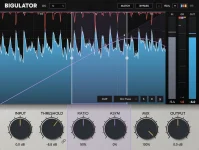
Bigulator can split audio into as many as three bands and run each band through its own instance of the modeled clipping circuit. The crossover is therefore not just housekeeping before the interesting part begins.
Minimum Phase, Linear Phase, and Linear Phase Deep all divide the spectrum, but they do not hand identical time-domain waveforms to the nonlinear stage. Once Bigulator clips those separate bands, small timing and shape differences at the crossover can become part of the distortion itself.
The Bigulator 1.0.1 crossover update makes split frequencies easier to enter precisely, but choosing the number is only half the job. Phase mode decides how the filters get there, and the result matters more when those filtered signals immediately hit an audio-rate peak skimmer.
Clipping is nonlinear, so you cannot assume those changes disappear when the bands are summed again. A kick containing low fundamental energy, midrange knock, and upper click can arrive at the separate clipping stages with a different instantaneous peak structure than it had before the split. Change the phase behavior, and you can change which band crosses its threshold first or hardest.
This is the important bit. A crossover can measure neatly in frequency response while still changing the shape of a transient in time, and Bigulator reacts directly to waveform amplitude because its modeled VCA has no conventional attack or release envelope. The splitter and the clipper are therefore part of one practical system.
Minimum phase also keeps its filter response causal, with ringing following the main event rather than being symmetrically distributed around it. On sharp transients, that tends to preserve the sense that energy begins with the hit, although frequency-dependent phase rotation remains part of the bargain.
A controlled comparison of minimum-phase distortion and linear-phase pre-ringing found no statistically significant difference in perceived impairment for the tested monophonic headphone material. Useful context, because pre-ringing is a real filter property without being an automatic audible disaster every time linear phase appears in a plugin.
Bigulator's Linear Phase mode can make sense when you want band separation without the frequency-dependent phase rotation of the minimum-phase option. It still does not leave the waveform untouched. Band-limiting itself changes time-domain shape, and the symmetrical filter response can smear a sufficiently sharp event slightly before and after its original position.
Linear Phase Deep pushes the separation harder. Its steeper filtering reduces overlap between neighboring bands, but it requires more latency, which Bigulator reports so the host can compensate. Stronger separation can be useful when one troublesome range needs its own Ratio or ASYM setting without dragging as much nearby material into the same nonlinear stage.
This means a steep crossover does not guarantee perfectly independent bands after distortion. The split controls what enters each Bigulator stage. The nonlinear stage then creates new frequency content, and those products are summed with whatever the other bands generated.
Overlap can sometimes make the transition feel more cohesive because neighboring bands share more source material before clipping. Deeper separation can make per-band settings more surgical, but an aggressive Threshold or Ratio difference between adjacent bands may also make the crossover region feel less unified once each side generates its own harmonics.
The useful test is boring and quick. Set Bigulator to one band first, establish the amount of clipping you actually want, then move to multiband without changing the target loudness. Try Minimum Phase, Linear Phase, and Linear Phase Deep on the same transient-heavy passage while watching which bands produce gain reduction.
Listen around the crossover instead of listening for some vague improvement in quality. If a kick loses its snap, a snare develops a soft lead-in, or one frequency range starts sounding detached after you increase the separation, the phase mode is contributing to the clipping result. Keep the mode that solves the band problem with the least unwanted time-domain baggage.
Minimum Phase, Linear Phase, and Linear Phase Deep all divide the spectrum, but they do not hand identical time-domain waveforms to the nonlinear stage. Once Bigulator clips those separate bands, small timing and shape differences at the crossover can become part of the distortion itself.
The Bigulator 1.0.1 crossover update makes split frequencies easier to enter precisely, but choosing the number is only half the job. Phase mode decides how the filters get there, and the result matters more when those filtered signals immediately hit an audio-rate peak skimmer.
The crossover changes the waveform before clipping
A minimum-phase crossover changes magnitude and phase together around its cutoff regions. The bands can still be designed to recombine with a flat overall frequency response, yet the individual waveforms feeding Bigulator's clipping stages have already been phase rotated.Clipping is nonlinear, so you cannot assume those changes disappear when the bands are summed again. A kick containing low fundamental energy, midrange knock, and upper click can arrive at the separate clipping stages with a different instantaneous peak structure than it had before the split. Change the phase behavior, and you can change which band crosses its threshold first or hardest.
This is the important bit. A crossover can measure neatly in frequency response while still changing the shape of a transient in time, and Bigulator reacts directly to waveform amplitude because its modeled VCA has no conventional attack or release envelope. The splitter and the clipper are therefore part of one practical system.
Minimum phase also keeps its filter response causal, with ringing following the main event rather than being symmetrically distributed around it. On sharp transients, that tends to preserve the sense that energy begins with the hit, although frequency-dependent phase rotation remains part of the bargain.
Linear phase trades rotation for ringing and delay
Linear-phase filtering keeps phase delay consistent across frequency instead of rotating different frequency components by different amounts. The price is an impulse response that extends on both sides of the main event, which can place some ringing before a transient.A controlled comparison of minimum-phase distortion and linear-phase pre-ringing found no statistically significant difference in perceived impairment for the tested monophonic headphone material. Useful context, because pre-ringing is a real filter property without being an automatic audible disaster every time linear phase appears in a plugin.
Bigulator's Linear Phase mode can make sense when you want band separation without the frequency-dependent phase rotation of the minimum-phase option. It still does not leave the waveform untouched. Band-limiting itself changes time-domain shape, and the symmetrical filter response can smear a sufficiently sharp event slightly before and after its original position.
Linear Phase Deep pushes the separation harder. Its steeper filtering reduces overlap between neighboring bands, but it requires more latency, which Bigulator reports so the host can compensate. Stronger separation can be useful when one troublesome range needs its own Ratio or ASYM setting without dragging as much nearby material into the same nonlinear stage.
Steeper separation can make band clipping less forgiving
More isolation sounds automatically better until the processing after the crossover stops being linear. A narrow band driven hard can develop harmonics that extend beyond the frequencies originally assigned to it, so the output of the clipper is no longer confined to the tidy spectral box created before processing.This means a steep crossover does not guarantee perfectly independent bands after distortion. The split controls what enters each Bigulator stage. The nonlinear stage then creates new frequency content, and those products are summed with whatever the other bands generated.
Overlap can sometimes make the transition feel more cohesive because neighboring bands share more source material before clipping. Deeper separation can make per-band settings more surgical, but an aggressive Threshold or Ratio difference between adjacent bands may also make the crossover region feel less unified once each side generates its own harmonics.
The useful test is boring and quick. Set Bigulator to one band first, establish the amount of clipping you actually want, then move to multiband without changing the target loudness. Try Minimum Phase, Linear Phase, and Linear Phase Deep on the same transient-heavy passage while watching which bands produce gain reduction.
Listen around the crossover instead of listening for some vague improvement in quality. If a kick loses its snap, a snare develops a soft lead-in, or one frequency range starts sounding detached after you increase the separation, the phase mode is contributing to the clipping result. Keep the mode that solves the band problem with the least unwanted time-domain baggage.